
Your Shoppers No Longer Have a Single Starting Point
Think about how a customer used to discover a product. They'd type something into Google, land on a retailer's website, browse a few pages, and either buy or leave. Linear. Predictable. Relatively easy to optimise for.
That journey is gone.
Today's shopper might start on Instagram, compare options on a brand's mobile site, ask ChatGPT for a second opinion, then circle back to a product page they half-remember seeing three days ago. The path to purchase has fractured - and the starting point for any given session depends entirely on what the customer is trying to accomplish in that moment.
This isn't a minor behavioural twitch. It's a structural shift in how people shop, and most ecommerce stores are still built to handle the old version of it.
AI Is Already Influencing Purchase Decisions - More Than Most Stores Realise
The numbers here are telling. According to Drapers' Connected Consumer 2026 research, one in ten shoppers now uses AI tools like ChatGPT, Claude or Google Gemini to browse for fashion - and 7% are acting on those recommendations with actual purchases.
That might sound small. But consider: these tools weren't built for shopping. They have no product catalogue integration, no inventory awareness, no affiliate relationship with your store. Shoppers are turning to them anyway - because they deliver something most product pages don't: a conversation.
When someone asks ChatGPT "what should I wear to a smart-casual outdoor wedding in June?" they're not looking for a category page. They're looking for guidance, context, and a recommendation that accounts for their specific situation. General-purpose AI tools are doing a rough job of that. Your store should be doing it better - on your own turf.
This is exactly what separates AI assistants from basic chatbots. A chatbot waits for a question and fetches an answer. A genuine AI shopping assistant interprets intent, understands context, and guides the shopper toward the right product - increasing the chance they actually buy.
The Mission-Driven Shopper Changes Everything
One of the most important concepts emerging from the research is that shoppers are now mission-driven rather than channel-loyal. They don't start on Google because they prefer Google. They start wherever gets them closest to their goal fastest.
Some visits are inspirational - they want to discover something new. Others are decisional - they've already made up their mind and just need to confirm stock or sizing. Others are problem-solving - they have a specific need and want someone (or something) to cut through the noise and just tell them what to buy.
Each of these missions requires a different kind of support. A static product page with a description and a size chart handles almost none of them well.
This is the gap that conversational commerce AI is designed to fill. When a shopper lands on your store mid-mission, an intelligent assistant can meet them where they are - whether they're exploring, comparing, or ready to buy - and move them forward rather than leaving them to figure it out alone.
What "Conversational Search" Actually Means for Your Store
The shift toward conversational search isn't just about AI chatbots. It reflects a broader change in how people express what they want. Instead of typing "blue linen trousers women," they're asking "what would go well with tan sandals for a summer holiday in Italy?"
That second query contains far more useful intent - but traditional site search can't interpret it. It's looking for keyword matches, not meaning. The result? Shoppers either get irrelevant results, give up, or - increasingly - take their question somewhere else entirely.
If your store's product discovery experience relies on a keyword search bar, you're already losing shoppers who think in natural language. And as AI tools become more embedded in daily life, the gap between what shoppers expect and what static search delivers will only widen.
We've written in depth about why the traditional search bar is quietly driving shoppers away - worth reading if product discovery is a weak point on your store.
The Danger of Waiting for One Channel to "Win"
Some store owners are still waiting to see which channel or platform becomes dominant before they invest. That's a risky strategy - and it fundamentally misreads what's happening.
No single channel is going to "win" the consumer journey. That's the point. The fractured path to purchase isn't a temporary disruption waiting to resolve itself into a new normal. It's the new normal.
What that means practically is that your store itself needs to become the most capable touchpoint in the journey. Not because you can control where shoppers start, but because you can control what happens when they arrive. If your on-site experience is passive - static pages, keyword search, no real-time guidance - you're leaving the hardest part of the conversion job undone.
The stores that are winning aren't the ones who figured out the perfect channel mix. They're the ones who made their own store the best possible destination once a shopper gets there.
Why AI Product Recommendations Are No Longer Optional
One specific area where the stakes are rising fast: AI product recommendations. When shoppers arrive having already had a conversation with an external AI tool, they've been primed to expect relevant, personalised suggestions. They've already experienced what "good" looks like.
Arriving on a product page that greets them with a generic "you might also like" carousel is a jarring downgrade. It signals that your store doesn't know them - and doesn't particularly care to.
A personalised shopping experience that accounts for what a shopper has told you - their occasion, their preferences, their constraints - is what converts. Not another static grid of products that may or may not be relevant.
What Stores Need to Do Differently Right Now
The practical implication of all this isn't "be on every channel." That's expensive and often diluted. The smarter move is to make sure your store can handle the shopper who arrives from any channel, at any stage of their journey, with any level of intent.
That means:
- Understanding intent on arrival - not just tracking page views, but understanding what the shopper is actually trying to accomplish
- Offering guidance, not just information - product pages inform; AI shopping assistants guide
- Handling natural language queries - if shoppers can't ask your store a question and get a useful answer, they'll ask somewhere else
- Recommending with context - suggestions that account for what the shopper has said, not just what they've clicked
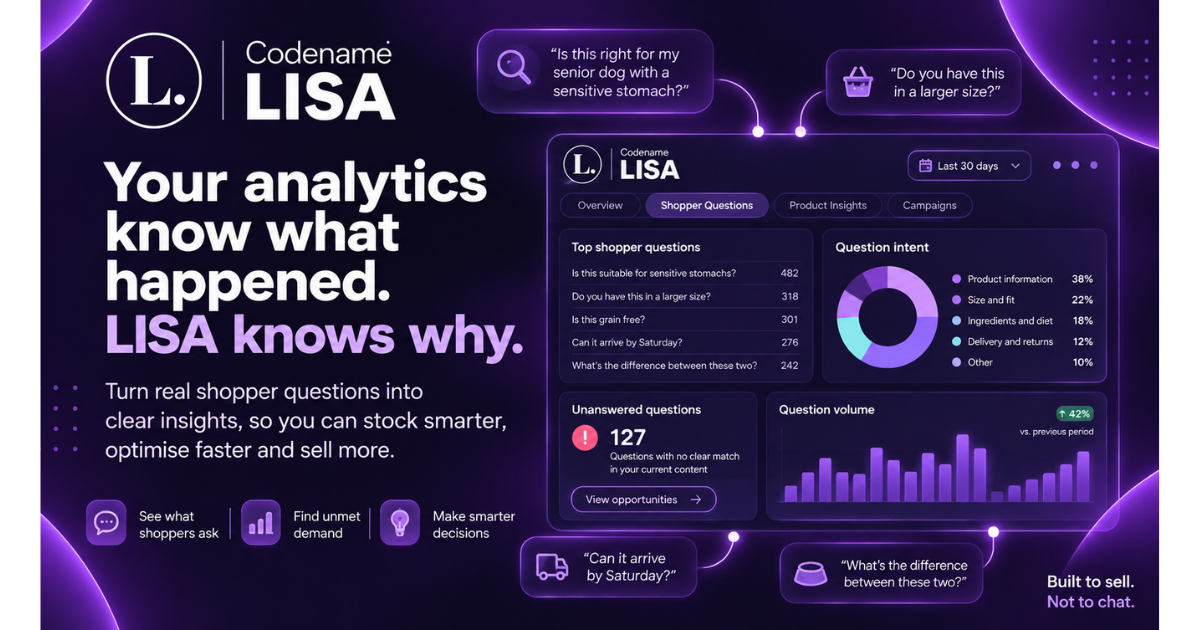
This is precisely what LISA does. As an AI shopping assistant for ecommerce, LISA holds real conversations with shoppers on your store - understanding their needs, asking the right follow-up questions, and guiding them to the products that genuinely fit. It's the in-store sales experience, rebuilt for online. And critically, it keeps that journey on your store rather than handing it off to a general-purpose AI tool that has no stake in your conversion rate.
If your store is still relying on passive discovery, it's worth asking: why are you still making shoppers buy alone?
This article was inspired by Drapers.
The way shoppers find and buy products has changed - and that change is accelerating. If you want to see how LISA can help your store meet shoppers wherever they are in their journey, book a demo and we'll show you what it looks like on your store.