
The Problem Isn't Your Team. It's What They're Being Asked to Do.
Picture a growing ecommerce business in its stride. Orders are up. Traffic is strong. The customer service team is working flat out - answering emails, managing live chat, responding to social media messages, chasing couriers and handling returns.
By every surface measure, things look healthy. But underneath, something is straining. Response times are creeping up. The same questions arrive every morning. Staff are staying late just to clear the backlog. And the business is quietly considering whether it's time to hire another support agent.
Before that decision is made, one question deserves a proper answer: why are so many customers contacting you in the first place?
Because if a significant proportion of those conversations are happening because the shopping experience didn't answer the question earlier - that's not a staffing problem. That's a shopping experience problem.
Warning Signs Your Team Is Under the Wrong Kind of Pressure
Some pressure is simply the result of growth. But there are patterns that suggest the workload is being driven by something more structural than volume alone.
1. Response Times Keep Slipping
Not just during peak periods - but as a creeping baseline. When the team is routinely slower than they used to be, and the enquiry volume hasn't dramatically changed, something in the mix of work has shifted.
2. The Same Questions Arrive Every Day
Delivery costs. Returns windows. Sizing guidance. Stock availability. If your inbox contains the same fifteen questions in slightly different formats, that's not a support challenge - it's a product information gap. According to Zendesk's Customer Experience Trends Report, the majority of customers say they expect to find answers without contacting support. When they can't, they reach out instead.
3. Agents Are Firefighting, Not Problem-Solving
When the team spends most of its time responding rather than improving, the operation becomes reactive. Systemic issues never get addressed because there's never a moment to look up from the queue.
4. Shoppers Contact You Through Multiple Channels in Sequence
Email, then live chat, then Instagram DM. When a customer escalates across channels, it usually means they needed an answer urgently and didn't get it fast enough. That's a signal about timing and accessibility, not just volume.
5. Complaints Are Rising Alongside Enquiry Volume
Slow responses create frustration. Frustration turns enquiries into complaints. What started as a simple question about a product becomes a dissatisfied customer. The original question was often answerable before the shopper even needed to ask it.
6. Staff Are Regularly Working Beyond Their Hours
Occasional overtime is part of running an ecommerce business. Consistent overtime is a sign that the workload has outpaced the structure designed to handle it.
7. Retention Is Becoming a Problem
Repetitive work, sustained pressure and difficult customer interactions combine to drain even committed team members. High turnover in support functions is expensive and disruptive - and often masks a more fundamental operational issue.
8. Shoppers Are Leaving Without Buying Because They Can't Get an Answer
This is the one that most directly connects customer service performance to commercial outcomes. A shopper is on a product page, genuinely considering a purchase. They have a question - about sizing, materials, compatibility, shipping time. They can't find the answer. They don't want to wait for an email response. So they leave.
That departure doesn't show up as a complaint. It shows up as a bounce, or a cart abandonment, or simply nothing at all. It's a sale that never happened, and it's invisible unless you're looking for it. As explored in our piece on why 67% of shoppers leave without buying, the most damaging exits often happen in silence.
9. Customer Service Costs Are Rising Faster Than Sales
Adding headcount to manage enquiry volume is sometimes necessary. But if the cost of support is growing faster than revenue, the business isn't scaling - it's absorbing.
10. Thousands of Conversations, Almost No Insight
This is the most underrated warning sign of all. Every customer question is a data point. It tells you what the shopper needed, what they couldn't find, what almost stopped them buying and - crucially - what the website or product page failed to communicate.
Most ecommerce businesses collect this data in inboxes and chat logs and never look at it systematically. The result is a team that answers the same questions indefinitely, with no mechanism to fix the underlying cause.
The Question Your Analytics Can't Answer
Ecommerce analytics are excellent at measuring what happened. Page views, click rates, conversion rates, cart abandonment percentages. But they have a fundamental blind spot: they can't tell you why something happened.
A product page view doesn't reveal whether the shopper was confused about the size range, unsure whether the product would work for their specific need, or just browsing. A cart abandonment doesn't tell you whether the question that stopped the purchase was even one you could have answered.
Customer conversations fill that gap. They contain the reasoning behind behaviour - and most retailers aren't reading them as strategy, only as support tickets.
Analysing your last hundred enquiries by category - product discovery, product detail questions, delivery and returns, order status, complaints - often produces a striking result. A large proportion of what looks like support work turns out to be pre-purchase decision-making. Shoppers not looking for help after something went wrong, but trying to decide whether to buy at all.
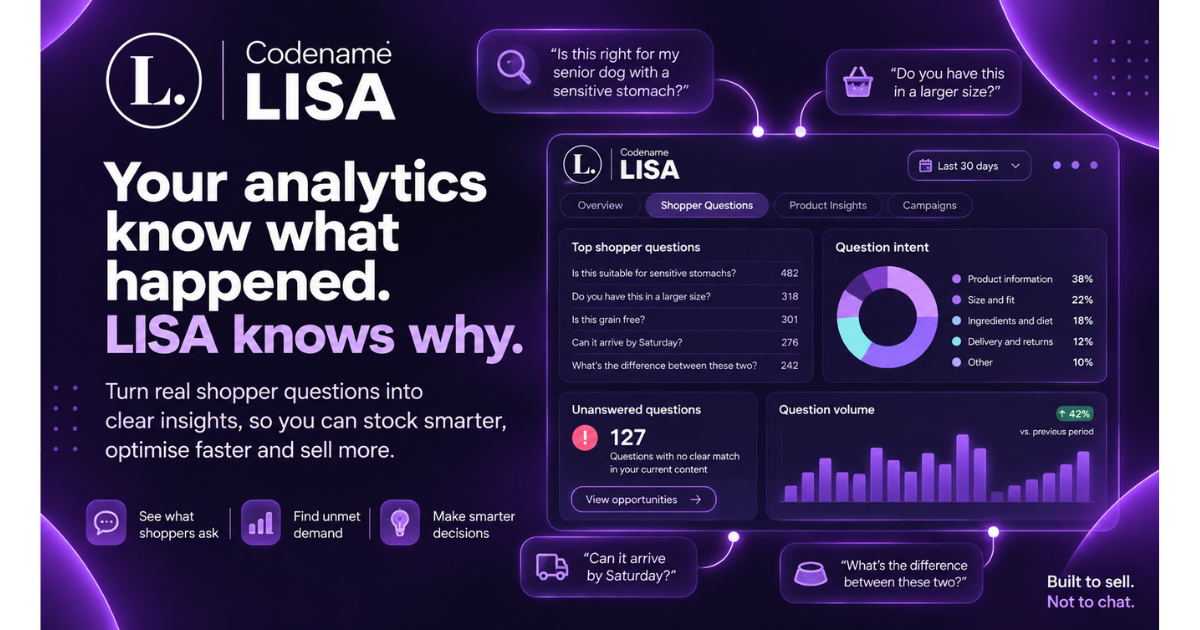
This connects directly to the intelligence hiding in plain sight, as covered in our piece on what traditional analytics consistently misses.
The Difference Between Support and Selling
Ecommerce businesses often handle every inbound message as a support ticket, regardless of whether the customer has a problem or a question. But there's a meaningful distinction worth drawing.
Customer support is typically about resolving something that went wrong - a delayed order, an incorrect item, a return that hasn't been processed.
Helping someone buy is different. "Which of these two products suits a sensitive skin type?" is not a complaint. "Do you have this in a smaller size?" is not a problem. These are questions that arise naturally during the shopping journey - and they're most valuable when answered at the moment they're asked, not hours later via email.
A shopper asking whether a product is right for their needs isn't necessarily reaching out for support. They may be one good answer away from completing a purchase. Treating that moment as a ticket to be queued is one of the most commercially costly mistakes in ecommerce operations. This is precisely the distinction we explored in depth when comparing chatbots and AI shopping assistants.
What to Actually Do About It
Before adding headcount, work through the following in order.
Audit Your Enquiries
Categorise the last 100 messages your team received. How many were repetitive? How many came from shoppers still considering a purchase? How many exposed missing or unclear information on your website? The answers will tell you whether you have a staffing problem, an information problem or a discovery problem.
Close the Information Gaps
Use actual customer questions to rewrite product descriptions, sizing guides, returns policies and delivery information. The questions in your inbox are a direct brief for your content team.
Make Answers Findable Without Contacting You
Not through a buried FAQ, but through clear product page information, visible policies and - increasingly - AI-powered assistance that can answer in natural language while the shopper is still browsing. This is where customer support automation shifts from a cost-saving measure to a genuine commercial tool.
Introduce Automation Where It Makes Sense
Routine questions about policies, product availability and shipping timelines don't require human judgement. Automating them frees your team to focus on situations that genuinely do - complaints, complex queries, returns that need handling with care.
The key condition: automation must never trap customers in a loop. When a question can't be resolved, there must be a clear and fast route to a person.
Treat Conversations as Business Intelligence
The questions your customers ask - particularly the ones asked before purchase, and the ones you couldn't answer - are among the most valuable inputs available to your merchandising, marketing and product teams. Build a process for reviewing them, not just closing them.
Where LISA Fits Into This
LISA is an AI shopping assistant built for ecommerce stores. It works directly with your product catalogue and store policies to help shoppers while they're actively browsing - answering questions about products, sizes, materials, delivery windows and returns, all in natural language, on the page, at the moment the question arises.
When a question goes beyond what LISA can answer, it hands the conversation to a human - through Gorgias or email - without losing the context of what was asked.
Beyond the shopper experience, LISA gives merchants visibility into what their customers actually asked - including the questions that went unanswered. That data feeds directly into the kind of audit described above, turning every conversation into a signal rather than just a transaction.
LISA doesn't replace a support team. It handles the questions that shouldn't need a support team in the first place - the pre-purchase, product-specific, decision-driving questions that currently land in the inbox and slow everything down.
A Quick Health Check for Your Operation
Ask yourself - and your team - the following:
- Are response times increasing without a clear spike in order volume?
- Are agents answering the same questions every single day?
- Can shoppers find clear answers to common questions without contacting you?
- Do you know which questions customers ask before they buy?
- Can shoppers get answers outside your support hours?
- Are human agents spending the majority of their time on genuinely complex issues?
- Do you systematically review unanswered or unresolved questions?
- Are customer conversations informing your product pages and marketing?
There's no score attached to this. But if several of those questions produce uncomfortable answers, the issue probably isn't the size of your support team. It's what they're being asked to field.
The Most Useful Shift in Thinking
When a customer service team is visibly struggling, the instinct is usually to add resource. Occasionally, that's exactly the right call. Genuine demand growth requires genuine capacity.
But more often, the queue is full of questions that could have been answered earlier - on the product page, through better information design, or through an assistant that's available when the shopper is actively deciding.
The most effective way to reduce pressure on your support team may simply be to stop routing shopping questions through a support system.
Your team's time is too valuable to spend answering "what's your returns policy?" for the four hundredth time. And your shoppers' patience is too limited to wait for an email when they're ready to buy right now.
If you'd like to see how LISA handles pre-purchase questions and what it surfaces from those conversations, book a demo and we'll show you what it looks like on a store like yours.