
The Evidence Is In. Assisted Shoppers Buy More. So Why Are So Many Retailers Still Doing Nothing?
There is a moment in every online shopping journey where the customer either commits or disappears. They have found something that might be right. They have a question. They are not quite sure. And then - nothing happens. No help arrives. They either push through the uncertainty and buy, or they leave.
For years, ecommerce optimisation has focused relentlessly on the checkout. Reduce steps. Autofill addresses. Add Apple Pay. Speed up the page. These things matter. But they assume the customer has already made their decision. The harder problem - helping customers reach a decision - has largely been left to search bars, filter menus and product descriptions.
The data now suggests that approach is leaving a significant amount of revenue on the table.
What Amazon's Rufus Numbers Actually Tell Us
Amazon disclosed that more than 300 million customers used its Rufus AI shopping assistant in 2025, and that those interactions contributed to nearly $12 billion in incremental annualised sales. But the figure that deserves closer attention is this: customers who used Rufus during a shopping trip were more than 60% more likely to complete a purchase.
That statistic is not an AI hype claim. It is a commercial outcome reported by one of the world's most analytically rigorous retailers. And what it describes is not a loyalty programme or a discount strategy. It describes what happens when a shopper who has a question gets an answer - at the moment they need it, on the page where the decision is being made.
Amazon did not build Rufus as a customer service channel. It built it into the shopping journey itself, giving customers a way to ask questions, compare options and feel confident enough to buy. That distinction matters enormously. There is a meaningful difference between an AI that answers queries and one that actively moves the shopper toward a purchase.
The Evidence Extends Well Beyond One Retailer
Amazon's results would be striking enough on their own. But the wider data from 2025 points in the same direction.
Adobe's analysis of the 2025 holiday shopping season found that visitors arriving at retail websites via generative AI assistants converted 31% better than shoppers from other traffic sources, and generated 254% more revenue per visit. On Black Friday specifically, AI-referred shoppers converted 38% better than the average. These are not marginal uplifts - they are commercially transformative differences in behaviour.
Salesforce's 2025 holiday data told a similar story. AI and agents influenced 20% of global online retail sales over the holiday period - representing $262 billion. Shoppers arriving through AI-powered discovery channels like ChatGPT and Perplexity converted nine times more often than those coming from social media.
More recently, Salesforce's July 2026 State of Commerce research reported that shopping journeys beginning with agentic search had grown 200% year on year. The direction of travel is unmistakable. Shoppers are actively choosing AI-assisted paths to purchase - and those paths are converting at a dramatically higher rate.
So Why Are Most Retailers Still Waiting?
The same Salesforce research also found that only 28% of commerce organisations currently use agentic AI, despite 44% saying they plan to adopt it within the next six months. That gap - between what the data shows and what retailers have actually done - is the most important question in ecommerce right now.
Consumers appear to be changing their shopping behaviour faster than many retailers are changing their websites. Why?
There are understandable reasons. Retailers who have spent years carefully optimising a website that converts reasonably well are right to be cautious about introducing something unfamiliar. Concerns about AI giving incorrect product information are legitimate. Previous experiences with basic chatbots - the kind that loop endlessly through scripted menus - have left a justified scepticism about what conversational tools can actually deliver. Questions about customer data, brand control and ROI are not unreasonable obstacles. They are the right questions to be asking.
Internal complexity is also real. Getting ecommerce, customer service, IT and marketing teams aligned around a new tool is genuinely difficult. And there is always the temptation to wait for the technology to become more "proven" before committing.
But waiting carries its own cost. The retailers who treat AI adoption as something to defer until conditions are perfect are already falling behind those who are learning through action.
The Assumption Worth Challenging
There is one particular belief that deserves more scrutiny: the idea that shoppers who cannot find what they need will simply keep trying.
They often do not. The default outcome for an uncertain shopper is not persistence - it is departure. They close the tab. They check a competitor. They decide to think about it later, which usually means never.
Traditional ecommerce is built on an implicit assumption: that the customer will do the work of translating what they want into the structure of the retailer's catalogue. They must find the right search term. They must understand which category to browse. They must apply the correct filters. They must read enough product descriptions to feel confident.
Conversational shopping reverses that relationship entirely. The shopper explains what they need in their own words, and the technology navigates the catalogue on their behalf. That shift sounds subtle. Commercially, it is not.
Getting Shoppers There Is Only Half the Problem
Much of the current conversation around AI in ecommerce focuses on discovery - appearing in ChatGPT, Gemini or Perplexity results so that AI agents bring shoppers to a retailer's website. That is a legitimate and growing strategic priority.
But it frames only half the challenge. Getting a shopper to arrive is one thing. What happens next is another entirely.
When that shopper lands on a product page and has a question about sizing, they are on their own. When they want to know whether a product is compatible with something they already own, there is no one to ask. When they need a small piece of reassurance about returns before they will commit, they have to go looking for it - and many will not bother.
This is where onsite conversational assistance becomes commercially interesting, and where the Rufus data provides its most useful lesson. Amazon's 60% uplift in purchase likelihood is not evidence that AI is magic. It is evidence that shoppers who get their questions answered at the right moment are significantly more likely to buy. That principle applies whether the retailer is Amazon or an independent store with a few thousand products.
What Onsite Assistance Actually Looks Like
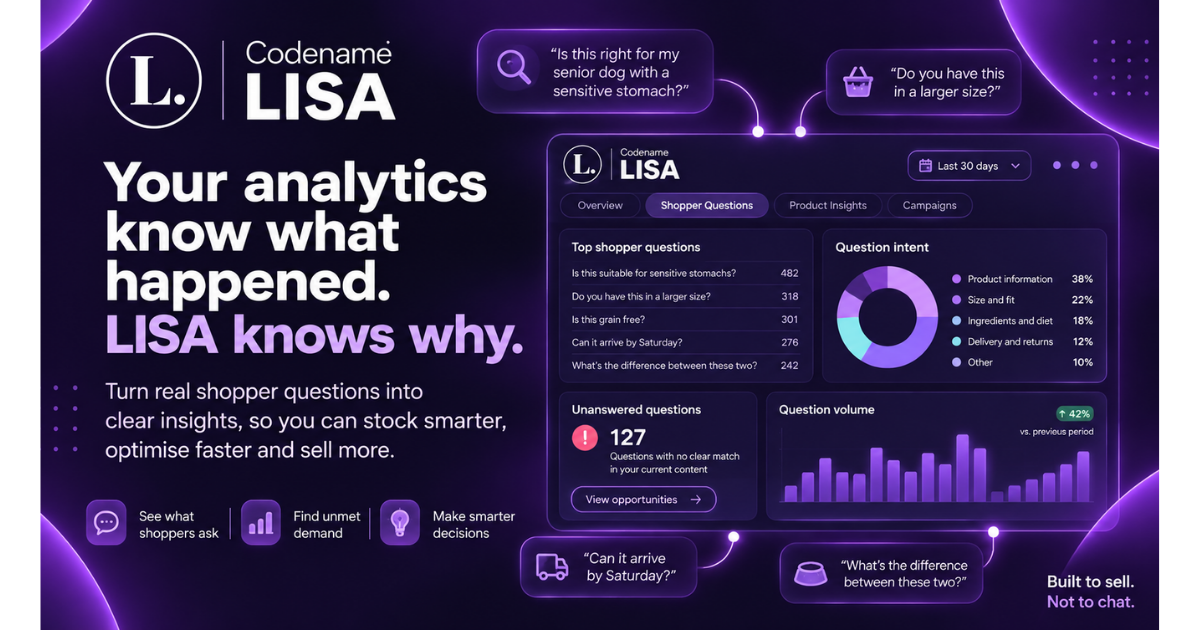
This is the problem LISA is built to solve. Rather than sitting in a support widget or a separate help centre, LISA operates on the product page - where the buying decision is actually happening. It answers product questions, helps shoppers identify the right option, clarifies sizing and compatibility, explains shipping and returns, and guides shoppers through a catalogue using their own language rather than the retailer's taxonomy.
Critically, it works from the merchant's actual product data and policies. That matters for accuracy, for brand consistency, and for the legitimate concern that a generic AI might say something misleading or unhelpful.
There is a second benefit that often gets less attention than it deserves. Every conversation generates intelligence that traditional analytics cannot capture. Clickstream data tells a retailer what a shopper did. A conversation reveals what they were actually trying to find - and which questions they needed answered before they could buy. LISA surfaces that data, giving merchants insight into the friction points that are invisible in a standard analytics dashboard. Understanding what customers are actually asking is itself a conversion strategy.
A Question for Ecommerce Leaders
The ecommerce industry has spent a decade obsessing over checkout optimisation - and rightly so. Removing friction from the final step of the purchase journey was the right priority when it was the biggest problem.
But the data now points to an earlier and larger opportunity: helping customers make the decision to buy in the first place. That is a different challenge, and it requires a different kind of tool.
If Amazon - with access to more ecommerce data than any other organisation on the planet - has concluded that assisted shoppers are substantially more likely to purchase, retailers of every size should at minimum be asking themselves a direct question: is leaving every visitor to navigate the website entirely alone still the best customer experience we can offer?
The answer used to be yes, because there was no practical alternative. That is no longer the case.
If you want to see how LISA works in practice on your own store - answering the questions that stop shoppers buying, while generating the insight that tells you what to fix - book a demo and we will show you exactly what that looks like.