Your Chatbot Is Answering Questions. But Is It Actually Selling?
There is a version of "AI for ecommerce" that has become depressingly common. A widget appears in the corner of a product page. A shopper types a question. The widget returns a policy statement, or a link to a FAQ, or a canned response that could have come from a help article written in 2019.
The shopper still doesn't know which product to buy. They leave.
This is the gap that almost no one in ecommerce talks about honestly - the difference between a tool that retrieves information and one that moves a shopper toward a confident purchase decision. They are not the same thing. Not even close.
What a Chatbot Actually Does
Traditional chatbots are, at their core, lookup tools with a conversational skin. Ask about shipping - get the shipping policy. Ask about returns - get the returns window. Ask whether a product is right for you - get a product description you could have read yourself.
That has its place. Reducing repetitive support tickets is genuinely useful. But answering a question and resolving a purchase decision are fundamentally different jobs - and conflating the two is costing stores real revenue.
According to the Baymard Institute, the average documented online cart abandonment rate sits at nearly 70%. A significant portion of that abandonment happens not because shoppers don't want to buy, but because they hit a moment of uncertainty and nobody - and no tool - helped them through it. A chatbot that recites policy text is not equipped to handle that moment.
The Uncertainty Problem Is the Conversion Problem
Most shoppers don't abandon stores because they dislike the product. They leave because they're unsure. Unsure whether this is the right variant. Unsure how it compares to the alternative. Unsure whether it fits their specific situation. That uncertainty is the real enemy of conversion - and it requires something more sophisticated than a retrieval engine to resolve it.
Think about the difference between these two interactions:
"Our return window is 30 days."
"You mentioned you're buying this as a gift and you're not sure of the exact size - in that case, I'd suggest the larger option, and here's why, along with what the exchange process looks like if needed."
The first answers a question. The second understands context, applies judgment, and helps someone make a decision. That's not a chatbot. That's a sales assistant.
The Capability Gap Is Wider Than You Think
The distinction between chatbots and true AI shopping assistants matters enormously in practice. A genuine AI shopping assistant for ecommerce doesn't just pattern-match queries to pre-loaded answers. It understands shopper intent. It knows when to ask a clarifying question rather than fire back a generic response. It can hold context across a conversation and use what it learns to surface the right products at the right moment.
That is a meaningfully different technology - and it produces meaningfully different outcomes. Ecommerce conversion optimization has long focused on page layout, button colours, and checkout flow. Those things matter. But the biggest conversion lever most stores haven't pulled is the quality of assistance they offer shoppers at the point of decision.
Intent Is Everything
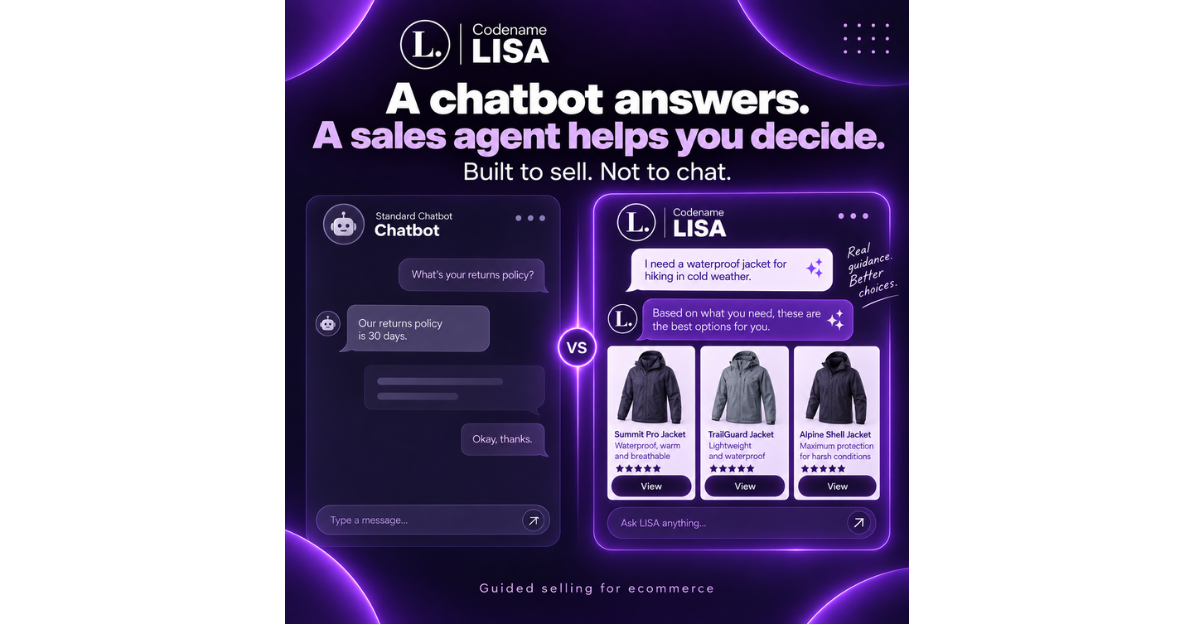
When a shopper types "which one is better for sensitive skin?" they are not asking for a product comparison table. They are signalling that they are ready to buy - if someone can help them feel confident about the choice. That is a high-intent moment. A chatbot will return a spec sheet. A proper conversational commerce AI will ask a follow-up question, understand the specific concern, and recommend the right option with a reason that actually lands.
The shopper doesn't want more information. They want less friction between where they are and a purchase they feel good about.
Why Most Stores Are Still Using the Wrong Tool
Part of the problem is that "AI" has become a catch-all term that obscures real differences in capability. A basic chatbot gets labelled as an AI assistant. A rules-based FAQ widget gets a rebrand. Merchants deploy these tools, see modest support ticket reductions, and assume they've addressed the AI opportunity in their store.
They haven't. Reducing support load is not the same as increasing revenue. And the tool that handles one well is rarely the tool that handles the other.
As we explored in our post on why AI that doesn't sell is just expensive hype, the benchmark for any AI investment in your store should be its impact on revenue - not just its impact on your inbox.
What "Built to Sell" Actually Means
An AI shopping assistant built to drive sales has to do several things that chatbots simply can't:
- Understand shopper intent - not just the literal words, but what the shopper is really trying to accomplish
- Know your catalogue deeply - not just product names and SKUs, but which products suit which use cases
- Ask smart questions - knowing when it needs more context before recommending, rather than guessing or deflecting
- Deliver AI product recommendations that feel personal - based on what the shopper has shared, not on what's trending site-wide
- Move the conversation forward - with a clear recommendation, a reason, and the confidence to close the loop
This is what separates a genuine personalized shopping experience AI from a glorified FAQ bot. The outcome isn't a shopper who got an answer. It's a shopper who made a purchase they feel good about.
The Cost of Getting This Wrong
Every high-intent shopper who lands on your store, hits a moment of uncertainty, types a question into your chatbot, gets a generic response, and leaves - that is a lost sale you never see on any dashboard. It doesn't show up as an error. It shows up as a conversion rate that refuses to move no matter how much traffic you drive.
This is the hidden revenue problem for most ecommerce stores. Not traffic. Not product quality. Not pricing. The absence of anything that can actually help a shopper decide. We've written about why 97 out of 100 shoppers leave without buying - and the pattern is consistent. Shoppers don't lack intent. They lack confidence.
A chatbot cannot give them that. An AI assistant built specifically to sell - one that understands intent, reads context, asks the right questions and delivers a confident recommendation - can.
LISA Was Built Around This Distinction
LISA wasn't designed to replace your support team or automate your FAQ page. She was designed to do the thing that actually moves revenue - helping shoppers who are ready to buy but not yet certain, navigate from uncertainty to a confident choice.
She understands your catalogue. She reads shopper intent. She asks questions when more context would lead to a better recommendation. And she gives shoppers a reason to buy - not just a wall of product information to process alone.
If your store is running a chatbot and calling it an AI strategy, it might be time to see what the real thing looks like. Book a demo with the LISA team and we'll show you exactly what a sales-focused AI assistant can do on your ecommerce store - with results measured in revenue, not resolved tickets.