
The Black Friday Gap Most Stores Never Close
Every year, the same pattern plays out. Store owners spend weeks in the lead-up to Black Friday tightening their ad budgets, negotiating supplier stock levels, scheduling email campaigns, and reviewing their discount strategy. The checklist gets ticked. The banners go live. The traffic arrives.
And then the gap opens.
Because while retailers have spent significant energy getting shoppers to their store, far fewer have thought seriously about what happens when those shoppers actually land on a product page and start to hesitate. That hesitation - the pause before a decision - is where Black Friday is really won or lost. And most stores are completely unprepared for it.
What Shoppers Actually Need in the Moment
Here's what your analytics won't tell you: your Black Friday visitors are not passive browsers. They arrive with intent, but also with questions. Lots of them.
Will this fit? Does it come in other colours? What's the delivery cut-off for Christmas? Can I return it if it's a gift? Is this the right product for my situation, or should I consider something else?
These are not edge-case queries from awkward customers. They are the normal internal monologue of someone who wants to buy but needs a nudge in the right direction. In a physical store, a sales assistant would handle this in thirty seconds. Online, most stores offer a FAQ page buried in the footer and a support inbox that takes 48 hours to respond.
According to research cited by Shopify, cart abandonment rates spike during peak shopping periods precisely because shoppers hit friction at the decision moment. That friction is not always about price. It is about uncertainty - and uncertainty, left unanswered, becomes an exit.
As we explored in why 97 out of 100 shoppers leave without buying, the overwhelming majority of your traffic is not converting, and the reasons are rarely what store owners assume.
Your Support Team Will Break. Plan for It.
Even stores with excellent customer service teams hit a wall during Black Friday. Volume spikes are not gradual - they are sudden and intense. The same team that handles fifty queries on a quiet Tuesday is suddenly fielding five hundred, across multiple channels, from shoppers who want answers right now because a deal expires in three hours.
The result? Slower response times, missed messages, and frustrated shoppers who simply go elsewhere. Many of those shoppers never come back.
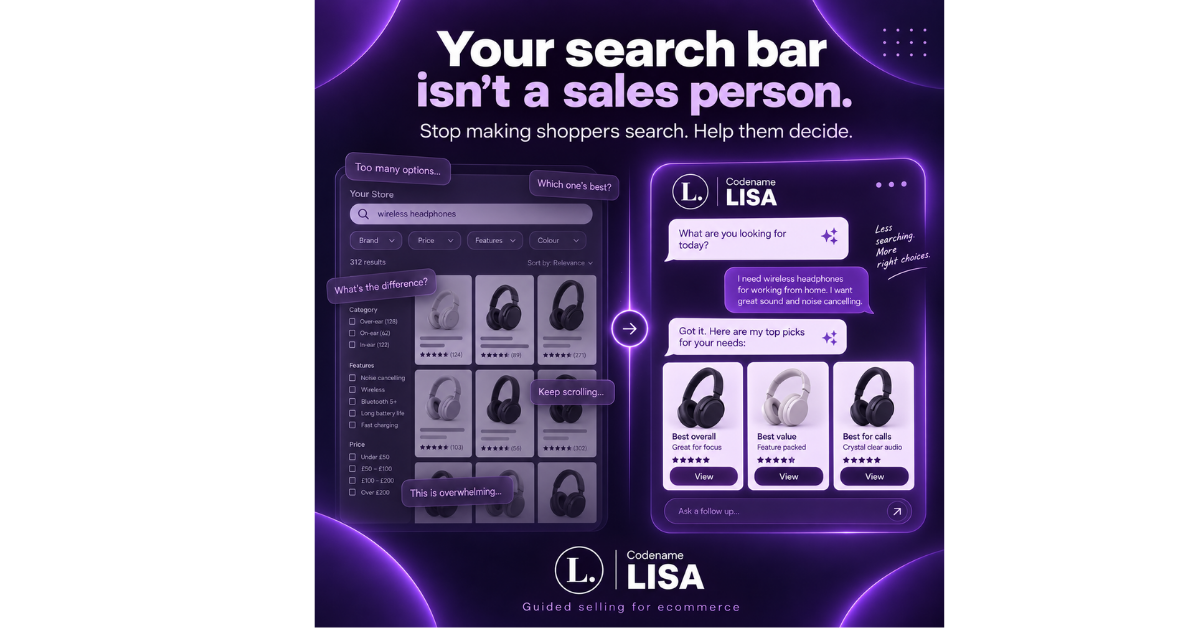
This is precisely where an AI shopping assistant for ecommerce changes the equation. Unlike a support inbox, an AI assistant engages shoppers while they are still on the page - still in buying mode, still warm. It can answer product questions, clarify shipping timelines, surface the right size or variant, and guide someone toward a confident purchase decision, all without a human agent needing to be involved.
LISA does exactly this. Rather than waiting for a shopper to abandon and then retargeting them with an email, LISA engages at the moment of hesitation - the moment that actually matters.
Speed Is Not the Only Metric That Matters
A lot of store owners think about support in terms of response speed. Fast reply equals good experience. But speed is only part of the picture. A fast reply that sends a shopper to a generic FAQ page does not resolve their uncertainty - it just shifts the friction point.
What shoppers need is a relevant, confident answer that moves them forward. That requires understanding what they actually asked, what product they are looking at, and what the most helpful next step is. This is conversational intelligence, not just automated messaging. There is a significant difference, and we have written about it in depth at chatbots answer, AI assistants sell.
AI Readiness Is Now a Black Friday Metric
There is another layer to this that most retailers have not yet fully absorbed: shoppers are increasingly using AI tools to research and discover products before they visit your store. Platforms like ChatGPT, Perplexity, and Google's AI Overviews are becoming product discovery channels in their own right.
If your product information is thin, inconsistent, or structured poorly, AI systems will either skip your products entirely or present them inaccurately to potential buyers. This is not a future concern - it is happening now, and the gap between AI-ready stores and everyone else is widening every month.
Being AI-ready means your product data, descriptions, and store structure are optimised not just for human visitors but for the AI systems those humans are now relying on. AI-referred traffic is exploding - the question is whether your store is positioned to capture it.
What You Know vs. What You're Missing
Most ecommerce analytics tell you what shoppers clicked, what they added to their basket, and what they bought. That is useful, but it is incomplete. What you almost certainly do not know is what they searched for and could not find, what questions they had that went unanswered, and which products they wanted that you did not surface.
This is the intelligence gap. And during Black Friday, when shopper intent is at its highest, that gap costs real revenue.
LISA Insights gives you a window into these hidden conversations. By capturing the questions shoppers actually ask during their visit, it reveals patterns in unmet demand - products to add, descriptions to improve, policies to clarify. Not just for the next campaign, but for every shopping period that follows.
Knowing what your customers tried to find but could not is arguably more valuable than knowing what they bought. It tells you exactly where your store is failing people who wanted to spend money with you.
The Black Friday Preparation Shift Worth Making
Here is a practical reframe for your 2026 BFCM preparation: instead of treating readiness as a logistics and marketing problem, treat it as an ecommerce conversion optimization AI opportunity. The question is not just "can our site handle the traffic?" - it is "can our store handle the shoppers?"
Those are different questions. Traffic handling is a technical problem with a technical solution. Shopper handling is a human problem - and it scales when you give AI the tools to support it.
A pre-Black Friday checklist worth running through:
- Are your product descriptions genuinely informative - or just keyword-stuffed copy that does not answer real questions?
- Is your returns and shipping policy clear at the point of decision - or buried somewhere shoppers will never look during a fast purchasing session?
- Do you have any mechanism to engage hesitating shoppers before they leave, rather than after?
- Is your product data structured in a way that AI systems can understand and surface accurately?
- Do you know what questions your shoppers are asking that your store is currently failing to answer?
If the honest answer to more than two of those is "not really," your store has work to do before November.
Find Out Where You Stand Before It's Too Late
The stores that will perform best this Black Friday are not necessarily the ones with the biggest ad budgets or the deepest discounts. They are the ones that have genuinely prepared for what happens when a motivated shopper arrives and needs a little help getting across the line.
LISA's Free AI Store Readiness Audit is designed to help you find out exactly where your store stands - before the traffic spike exposes the gaps. It looks at how your store and product information are structured for both human shoppers and the AI systems they increasingly rely on, and gives you a clear picture of what to prioritise.
Ask yourself honestly: how prepared is my store for Black Friday and the future of AI shopping? If you are not certain, that uncertainty is worth resolving now - not at 11pm on 27 November when your support queue is full and your ad spend is burning.
This article was inspired by the original article.
Book a demo with LISA today and find out what your store's AI readiness score looks like - and what a difference the right preparation can make when it counts most.