
When Gap Moves, Pay Attention
Gap Inc - the parent company behind Gap, Old Navy, Banana Republic and Athleta - has just signalled something important. It is overhauling how shoppers discover and buy clothing across its brands, replacing traditional keyword search and filter-based navigation with conversational, intent-driven AI shopping experiences.
This is not a small test. It spans multiple brands, multiple platforms, and includes third-party AI fashion partnerships designed to reach shoppers wherever they are - not just on Gap's own website.
For independent ecommerce store owners, this moment deserves a clear-eyed read. Not because you need to replicate what a billion-dollar retailer is doing, but because the direction of travel they are investing in is the same direction your customers are already heading.
The Real Problem Gap Is Solving
Gap's chief technology officer put it plainly: AI should make shopping easier and more intuitive, not add complexity or remove choice. That framing is worth unpacking, because it identifies the actual failure mode of most online stores right now.
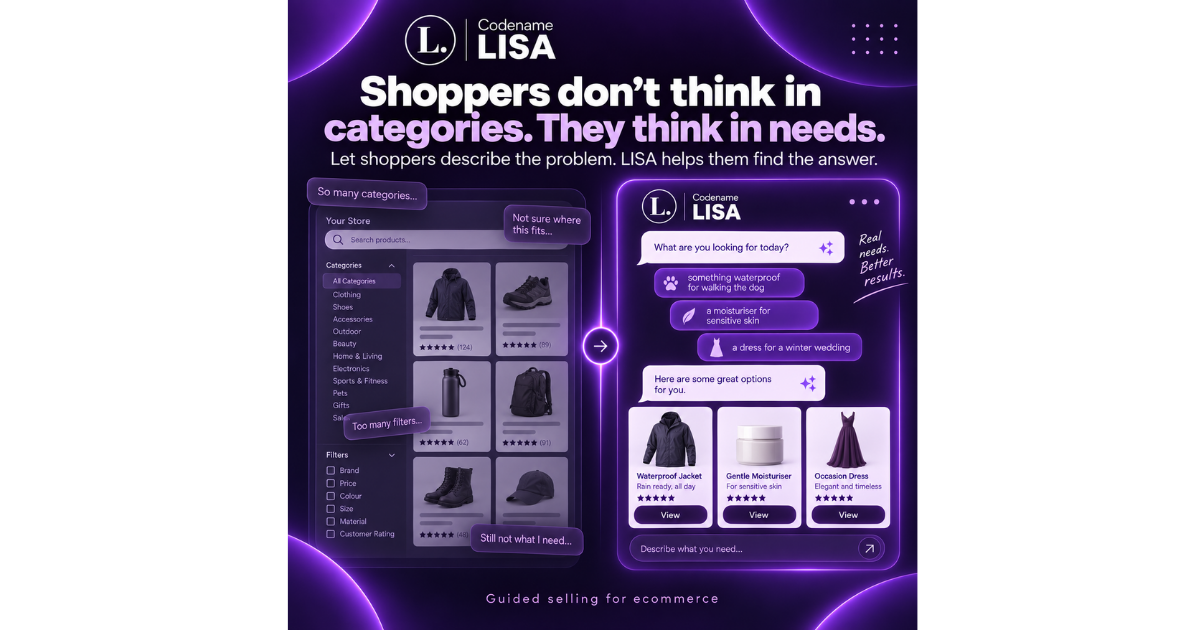
Traditional ecommerce forces shoppers to think like a database. To find what they want, they must translate a natural human need - "something smart but comfortable for a weekend event" - into the correct category, filter, size, and keyword combination. Most shoppers cannot or will not do this reliably. They either settle for something that does not quite fit, or they leave.
That friction is costing stores sales every single day. It is not a checkout problem or a pricing problem. It is a discovery problem - and it sits right at the top of the funnel, on the very pages where purchase decisions are forming.
As we explored in Why Traditional Product Pages Are Failing Your Store, the standard product browsing experience was built for a world where search was the only option. That world no longer exists for shoppers - but most stores have not caught up yet.
What "Conversational" Actually Means in Practice
It Is Not Just a Search Bar Upgrade
When Gap's brands allow shoppers to describe what they want in everyday language and receive relevant recommendations in return, that is a fundamentally different interaction model. It mirrors how a shopper would speak to a knowledgeable friend or an in-store stylist - describing context, occasion, budget and preference rather than punching in search terms.
The technology underneath this experience is designed to interpret intent, not just match keywords. A shopper who types "something I can wear to a work dinner that doesn't look too formal" should not receive results for "smart casual trousers". They should receive a curated selection that genuinely reflects what they described - with the ability to refine from there.
This is what separates conversational commerce AI from a standard site search upgrade. It is not about better autocomplete. It is about understanding what a shopper actually means and guiding them toward the right purchase.
Third-Party AI Partnerships Signal a Broader Shift
Gap is also extending its product discovery into AI-native platforms outside its own store - including services that factor in a shopper's schedule, local weather, and existing wardrobe when making suggestions. This matters because it signals that the shopping journey increasingly starts somewhere other than a brand's homepage.
Shoppers are already using AI tools to research and narrow down purchases before they ever land on a product page. Stores that are not visible and well-structured for these AI-powered discovery pathways are quietly losing traffic they will never even know about. We covered this directly in AI-Referred Traffic Is Exploding. Is Your Store Ready?
Why This Matters More for Smaller Stores Than You Think
Here is where the framing often goes wrong. When a retailer the size of Gap announces an AI initiative, the instinct for smaller store owners is to file it under "things big brands do" and move on. That instinct is understandable - but increasingly dangerous.
The tools that underpin Gap's conversational shopping experience are not proprietary technologies built by an internal team of hundreds. They are platforms and integrations that represent the direction the entire ecommerce ecosystem is moving. The gap between what enterprise retailers offer shoppers and what independent stores offer is widening fast - and shoppers notice, even if they cannot articulate why.
A shopper who has experienced being guided, understood and recommended to on one store will feel the friction of keyword search and static filters far more acutely on the next one. The comparison is being made whether store owners are aware of it or not.
According to research cited by Salesforce, 65% of shoppers expect brands to adapt to their changing needs and preferences - yet most ecommerce stores still present an identical, static browsing experience to every visitor regardless of context or intent.
The Intent Gap Is Where Sales Are Lost
Gap's AI strategy is explicitly built around understanding a shopper's broader intent - not just the words they type, but the need underneath those words. This is the crux of where most ecommerce stores fail silently.
A shopper who lands on your store knows what problem they are trying to solve. They may not know which product solves it, which variant is right for their situation, or even how to search for it. If your store cannot meet them at the level of their actual need and guide them forward, they will leave - not because they did not want to buy, but because the experience did not help them feel confident enough to do so.
This is why ecommerce conversion optimization AI is not really about tweaking button colours or checkout flows. It is about building an experience that reduces decision uncertainty at every stage of the shopping journey - and that starts well before the cart.
We wrote about this dynamic in AI Personalisation's Missing Piece: Intent - and the argument has only become more urgent since.
What a Conversational Shopping Experience Should Do
If you take Gap's direction seriously - which you should - the question becomes: what does this actually look like for a store that is not a global fashion brand with enterprise resources?
A well-implemented AI shopping assistant for ecommerce should be able to:
- Understand natural language queries - not force shoppers to adapt to your category structure
- Surface relevant products based on stated context - occasion, budget, use case, preference
- Offer genuine guidance - not just a list of search results, but a recommendation with reasoning
- Handle follow-up questions in context - so the conversation builds rather than resets
- Support discovery across your full catalogue - surfacing products shoppers would never have found through traditional navigation
This is not a future capability. It is what LISA does right now, across ecommerce stores of all sizes. LISA engages shoppers in natural conversation, understands what they are actually looking for, and guides them toward the right product - increasing confidence, reducing friction, and turning more browsers into buyers.
The difference between Gap's rollout and what LISA enables for independent stores is simply scale. The underlying principle - that shoppers deserve to be understood, not just searched - is exactly the same.
The Window to Act Is Now
Gap's announcement is a signal, not a starting gun. The starting gun fired some time ago. Stores that implement conversational AI shopping experiences now are building familiarity and loyalty with shoppers before this becomes the expected standard. Stores that wait will be playing catch-up against both enterprise competitors and the rising baseline of shopper expectations.
The good news is that the technology is accessible. The better news is that the stores implementing it now are seeing measurable results - in conversion rates, in average order value, and in the quality of insight they gain about what their shoppers actually want.
This article was inspired by Retail Gazette.
If you want to see what a conversational shopping experience looks like on your own store - and what it could do for your conversion rate - book a demo with LISA and we will walk you through it with your actual products, your actual catalogue, and your actual customers in mind.