
You Have More Data Than Ever - And Less Customer Understanding Than You Think
Ask most ecommerce directors how their data strategy is going and they'll point you toward a dashboard. Sessions, bounce rate, average order value, conversion rate, revenue by channel. The numbers are all there, refreshing in real time, colour-coded and exportable.
And yet, most of those businesses couldn't tell you what their customers were actually trying to buy yesterday.
That's not a dig at analytics platforms. Tools like GA4, Hotjar and Klaviyo are genuinely useful. But there's a critical distinction between behavioural data - what your customers did - and intent data - what they were actually trying to achieve. Most ecommerce businesses are drowning in the former and almost completely blind to the latter.
That gap is costing stores far more than they realise.
The Problem With "What Happened" Data
Here's a scenario most ecommerce teams will recognise. A shopper visits your store, views five or six product pages, spends four minutes on the site and leaves without buying. Your analytics dutifully record the session. Bounce. Exit. Lost conversion.
What the data doesn't tell you is any of this: the shopper was looking for a lightweight waterproof jacket suitable for a walking holiday, needed it to pack flat into hand luggage, had a firm £150 budget, and simply couldn't work out from your product descriptions which option was right for them. They weren't uninterested. They were confused - and you never knew.
That lost shopper took genuinely valuable commercial intelligence with them when they left. Not just a missed sale, but a missed signal about what your product content is failing to communicate, what filtering your site is missing, what questions your category pages never answer.
Multiply that by thousands of sessions a week and you start to understand the scale of the problem. The data you don't capture is often more commercially useful than the data you do.
What Conversational AI Actually Makes Possible
There's been a lot of noise about AI in ecommerce - most of it focused on automation, cost reduction and chatbot efficiency. That framing misses the real opportunity entirely.
When a shopper types a question into a conversational AI assistant on your store, something genuinely new happens. They stop behaving like a user navigating a website and start behaving like a customer talking to a salesperson. They share context. They explain what they need. They reveal the problem they're trying to solve.
"I need something for my mum who has joint pain but won't take tablets." "We've got a rescue dog who's anxious around other dogs." "I want to get into running but I've never bought proper kit before."
These aren't just queries to be answered. They're windows into customer intent that traditional analytics will never surface - because a page view can't tell you who someone is buying for, what their actual constraint is, or what's making them hesitate. As we've explored before, shoppers think in needs, not categories - and your site architecture almost certainly isn't built to reflect that.
The Intelligence Hidden Inside Every Conversation
Think about what a single customer conversation can contain that your existing analytics stack will never capture:
- What the customer is actually trying to buy - not the category they clicked, the outcome they want
- Who they're buying for - themselves, a child, a parent, a pet
- Their real budget - stated openly, not inferred from which price filter they used
- The specific problem they need to solve - often far more nuanced than your product taxonomy allows for
- Features that genuinely matter to them - and crucially, features they expected to find but couldn't
- Products they asked for that you don't stock - a direct signal for buying and merchandising teams
- Recurring hesitations - questions that come up again and again but never get answered on the page
Now imagine that's not one conversation. It's 50,000 conversations over six months, continuously growing, structured and searchable. That's not a support log. That's a real-time research panel made up entirely of your actual customers, telling you exactly what they want and where your store is falling short.
This is why your analytics may be telling you less than you think. The data exists. But it's in the wrong format to act on.
Renting Intelligence vs Building It
Here's a question worth sitting with: when you introduce an AI tool into your store, who actually owns the resulting intelligence?
Many AI tools - particularly third-party chatbots and off-the-shelf recommendation engines - process customer interactions and surface answers, but keep the underlying conversational data locked inside their own platforms. The retailer gets a functional tool. The platform gets richer training data. The business learns almost nothing about its own customers.
That's a subtle but significant distinction. There's a real difference between renting AI capability and building genuine first-party customer intelligence.
First-party intent data - the kind generated when your own customers tell your store what they're looking for - is becoming one of the most valuable assets an ecommerce business can own. Unlike third-party behavioural data, it doesn't disappear when a platform changes its API. It doesn't require inference or modelling. It's your customers, in their own words, telling you what they need.
As the conversation around owned channels becoming the only safe channels in AI-driven commerce intensifies, the businesses building proprietary customer understanding now will have a structural advantage that's very difficult to replicate later.
What You Can Actually Do With This Data
The commercial applications of structured customer intent data extend well beyond conversion optimisation - though that alone is a significant prize. Consider what's genuinely possible when you start treating conversational intelligence as a business asset:
Merchandising and Buying
When you can see that customers are repeatedly asking for a product type you don't stock, or a variant you don't carry, that's a buying signal with real commercial weight behind it. Not a hunch. Aggregated customer demand.
Product Content and SEO
The questions customers ask before buying are almost always the questions Google users are typing too. Knowing which questions your product pages fail to answer tells you exactly where to invest in content - with far more precision than keyword research alone.
FAQs and Customer Experience
Most FAQ pages are built by internal teams guessing what customers want to know. Conversational data tells you what they actually ask - and how frequently. The result is support content that reduces friction rather than restating it.
Marketing and Campaign Strategy
When you know the language customers use to describe their own problems, you can write campaigns that genuinely resonate rather than relying on category language your customers would never use themselves.
Ecommerce Conversion Optimization AI
Knowing the specific point in the purchase journey where shoppers hesitate - and why - allows you to intervene precisely, rather than making broad UX changes and hoping conversion rates improve.
This Is What LISA Was Built to Do
LISA's proposition is built around two distinct but connected things. LISA Assist helps shoppers find and choose products through natural conversation - the kind of guided selling that reflects how people actually think about what they need, not how your site is categorised.
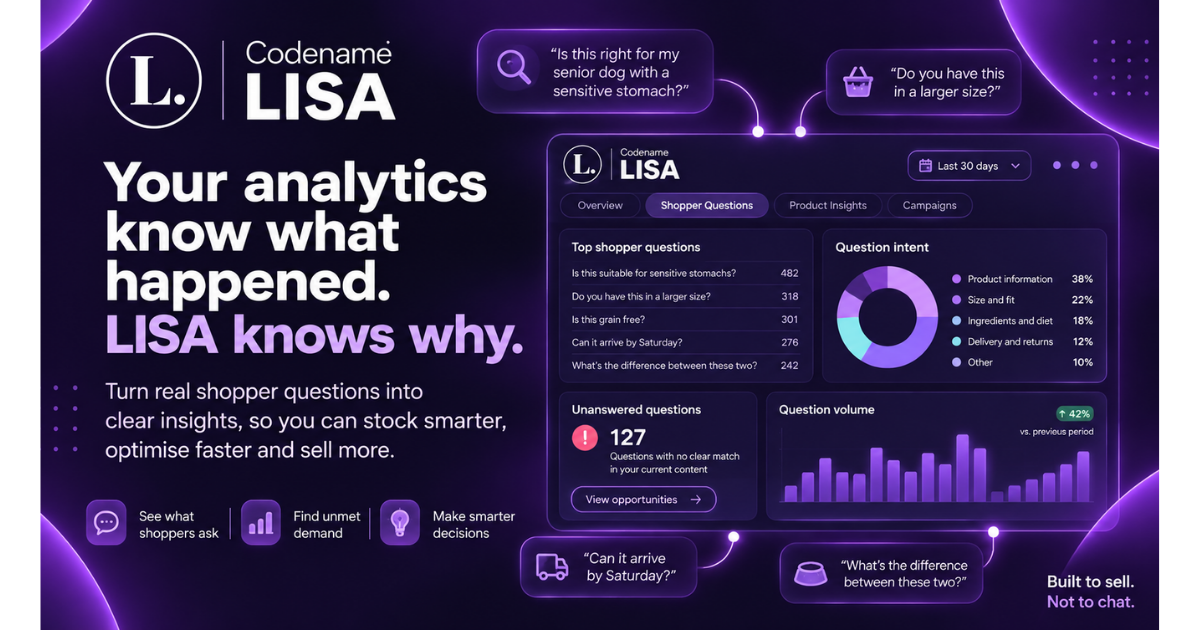
But LISA Insights is where the commercial intelligence lives. Every conversation becomes structured, searchable data. Merchants can see what shoppers are asking for, where hesitation is concentrated, which products are generating confusion, and what customer intent looks like across thousands of individual sessions.
The goal isn't to answer questions and move on. It's to build a continuously growing picture of what your customers actually want - owned entirely by your business, not a third-party platform.
Your analytics tell you what customers did. Their conversations can tell you why. And the "why" is where the commercially useful decisions get made.
The Question Worth Asking Yourself Today
You're already collecting clicks, searches, session data and transactions. That infrastructure is in place and it has real value. But here's what's worth examining honestly: how much valuable customer intent is currently disappearing from your store every single day, unrecorded and unexamined?
Every shopper who left without buying knew something your team doesn't. They knew what they were looking for, what was missing, what confused them and what would have made them buy. In most ecommerce businesses, that intelligence exits the store with them and is never seen again.
Changing that doesn't require a platform overhaul. It requires deciding that customer intent is worth capturing - and choosing tools that make it possible.
If you want to see what that looks like in practice, book a demo with the LISA team. We'll show you exactly how LISA surfaces customer intent data on stores like yours - and what ecommerce leaders are doing with that intelligence to make better decisions across their entire business.