
Your Shoppers Aren't Thinking About Your Catalogue. They're Thinking About Their Problem.
Here's a question worth sitting with: when a shopper lands on your store, what's actually going through their head?
It's not "let me browse the waterproof outerwear category." It's not "I'll filter by material type and then sort by price."
It's something more like: "I need something to wear on rainy dog walks that doesn't make me look like I've given up."
That's a need. It's specific, personal, and completely reasonable. But most ecommerce stores are built to receive the wrong version of it - the translated, filtered, keyword-friendly version that shoppers have to manually convert their real intention into before they can find anything useful.
That translation work? It's costing you sales.
The Hidden Effort You're Asking Shoppers to Do
Most store owners assume their navigation is intuitive. The categories make sense to them. The filters feel logical. The search bar is right there at the top of the page.
What they don't see is the invisible cognitive load being placed on the shopper the moment they arrive.
To find a product on a typical ecommerce store, a shopper has to:
- Understand your category structure well enough to navigate it
- Know the right terminology to search for
- Evaluate filter options that may or may not match how they think about the problem
- Scroll through results and mentally cross-reference their needs with each product listing
That is an enormous amount of work. And the moment it feels like too much effort - which often happens within seconds - they leave. Not because they didn't want to buy. Because you made buying too hard.
Research consistently shows that the vast majority of visitors leave stores without purchasing, and friction in the discovery process is one of the most underappreciated reasons why.
The Problem With Search Bars and Filter Menus
Search bars have always been positioned as the solution to product discovery. Can't find it by browsing? Just search for it.
But search bars have a fundamental flaw: they require the shopper to already know what they're looking for - and to express it in terms your catalogue can recognise.
Type "moisturiser for sensitive skin that won't feel greasy" into most ecommerce search bars and you'll get one of three outcomes: a list of vaguely relevant products with no explanation of why they match, a sparse results page that misses the intent entirely, or worse - zero results.
None of those outcomes move the shopper closer to a purchase. The search bar, for all its ubiquity, is still failing shoppers in ways most store owners haven't fully reckoned with.
Filter menus aren't much better. They're built around your product attributes - not around the way shoppers actually describe their needs. A shopper looking for "a dress for a winter wedding I can actually wear again" doesn't naturally think in terms of fabric weight, sleeve length, or occasion tags. They think in context and outcome.
What Happens When You Meet Shoppers in Their Own Language
The shift that changes everything is deceptively simple: let shoppers describe the problem in their own words, then help them find the answer.
This is what conversational commerce AI does at its best. Instead of asking shoppers to learn your catalogue, you provide something that listens, understands intent, and responds intelligently - the way a knowledgeable sales assistant in a physical store would.
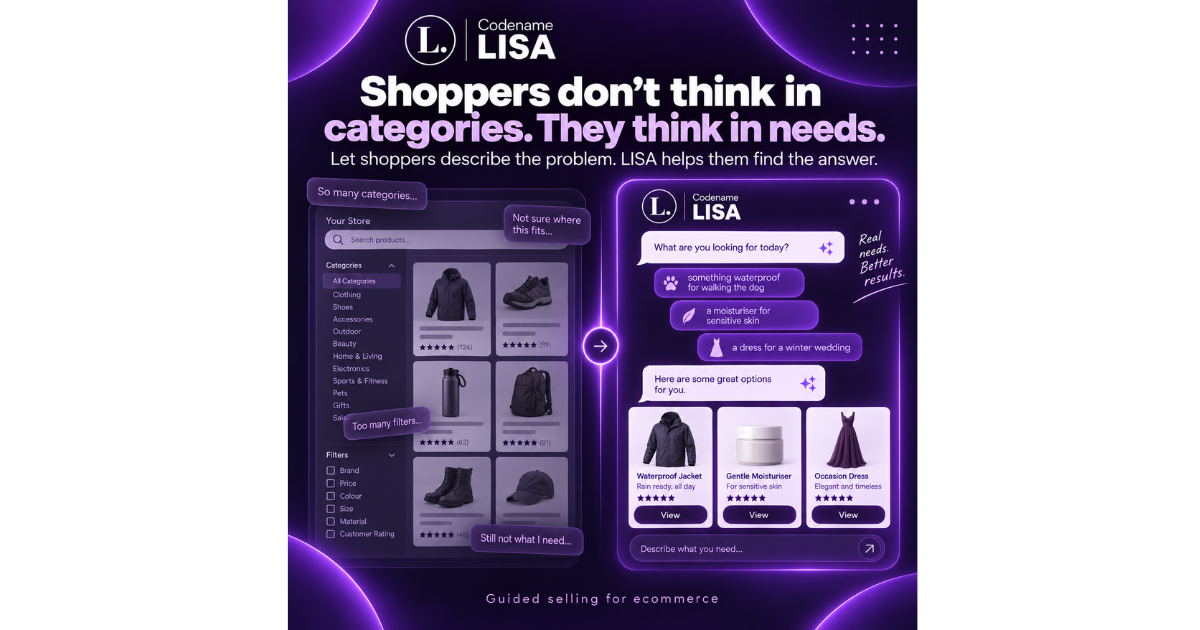
Think about the last time you were helped by someone genuinely good at their job in a retail environment. They didn't hand you a category map and walk away. They asked questions. They made connections between what you said and what was available. They filtered out the irrelevant and surfaced the things that actually made sense for your situation.
That's not a luxury reserved for premium in-person retail. It's what AI shopping assistant for ecommerce technology now makes possible at scale, around the clock, across every type of store.
The Follow-Up Question Changes Everything
One thing that separates genuine AI powered product finder experiences from basic search is the ability to ask a follow-up question when the picture isn't complete.
A shopper says they need something waterproof for walking the dog. A smart assistant doesn't just return every waterproof product in the store. It might ask: is this for warmer weather or cold? Are you looking for something casual or do you need it to work for other occasions too? What's your budget range?
Each answer narrows the field - not through filters the shopper has to apply themselves, but through a conversation that feels natural. The result is a recommendation that actually fits, rather than a list the shopper has to evaluate alone.
This is what personalized shopping experience AI genuinely looks like in practice. Not algorithmic product carousels based on vague browsing data. Actual, contextual guidance based on what the shopper told you they need.
The Cost of Getting This Wrong
If your store isn't meeting shoppers in their own language, the cost shows up in several places - most of them easy to misdiagnose.
High bounce rates on product pages often get blamed on page design or load speed. Sometimes that's true. But frequently, the real problem is that the shopper landed on a page that didn't quite match what they were looking for - because the discovery path that brought them there wasn't good enough.
Low conversion rates get attributed to pricing or trust signals. But a shopper who isn't confident they've found the right product won't buy, regardless of how competitive your price is or how many reviews you've collected.
High return rates often trace back to the same root cause. Shoppers who couldn't get proper guidance during discovery end up purchasing something that doesn't fully meet their needs - and send it back.
Fix the discovery problem, and you don't just improve conversion. You improve the quality of every transaction. The friction points bleeding your conversions are often hiding in plain sight.
How LISA Bridges the Gap Between Intent and Purchase
LISA is built around one core belief: shoppers shouldn't have to understand your catalogue before they can buy from it.
When a visitor arrives on a store powered by LISA, they can describe what they need in plain language. LISA interprets the intent behind that description, asks clarifying questions where it helps to narrow things down, and guides the shopper towards the products that genuinely fit - drawing on your actual inventory, in real time.
This isn't keyword matching dressed up as intelligence. It's intelligent product search chatbot capability that understands context, handles ambiguity, and improves the more it's used. The result is a shopping experience that feels less like navigating a warehouse and more like talking to someone who knows the stock and actually wants to help.
For store owners, the impact is measurable: higher conversion rates, fewer abandoned sessions, and customers who arrive at checkout already confident in what they've chosen.
Shoppers think in needs, not categories. The stores that recognise this - and build their discovery experience around it - are the ones that will continue to pull ahead.
If you want to see how LISA handles product discovery on your specific store, book a demo and we'll show you exactly how it works in practice.