
Your Analytics Are Telling You Half the Story
You open your dashboard. You can see exactly how many people visited your store yesterday, which products they viewed, where they dropped off and what your conversion rate looks like against last week. It all looks very professional. Very data-driven.
And yet - you still have absolutely no idea why that shopper who added a product to their basket at 11pm on Tuesday just... left.
This is the dirty secret of standard ecommerce analytics: they are extraordinarily good at recording events, and almost completely useless at explaining them. You get the what, delivered with impressive precision. The why remains stubbornly invisible.
That gap is not just frustrating. It is actively costing you sales - and the longer it stays open, the more you are flying blind on decisions that matter.
What "Good Data" Actually Looks Like in Most Stores
Picture a fairly typical shopper session. Someone arrives on your store, browses a few products, spends a little time on one specific page, then disappears without buying. Your analytics capture all of it with clean fidelity.
But here is what that data cannot tell you:
- Was the price a deal-breaker, or just a hesitation point?
- Did they need a specific size or variant that wasn't visible enough?
- Were they confused about which product in your range was right for their situation?
- Did they need it delivered before a specific date and couldn't confirm that?
- Was the product they actually wanted simply not there?
Each of those scenarios demands a completely different response from you as a store owner. A pricing problem requires a different fix than a navigation problem. A missing product requires a different fix than an unclear delivery policy. Yet your current data treats all of those exits exactly the same way: a bounce, a lost sale, a number.
According to Baymard Institute, the average documented cart abandonment rate sits above 70% - and the reasons shoppers give when surveyed span everything from unexpected costs to uncertainty about the right product choice. That is not one problem. That is dozens of distinct friction points being lumped together into a single vanity metric.
The Cost of Optimising Against the Wrong Diagnosis
Here is where this really starts to hurt. When you do not know why shoppers are leaving, you are forced to guess. And when store owners guess, they tend to reach for the most visible levers - redesigning a page, running a discount, tweaking ad spend.
Some of those guesses land. Many do not. And the ones that do not just quietly drain your budget without anyone noticing that the root cause was never actually identified.
This is why ecommerce conversion optimization AI is such a significant shift from traditional analytics tools. The goal is not to give you prettier charts of the same data. It is to surface the reasoning behind shopper behaviour - the intent, the confusion, the unmet need - so that you are responding to reality rather than your best guess at it.
If you have ever wondered why a page-level redesign did not move the needle, or why a new promotion drove traffic but not sales, there is a reasonable chance the diagnosis was off from the start. Hidden friction points rarely show up clearly in session data. They live in the gap between what shoppers were thinking and what they actually did.
What Conversational Commerce Changes About Intelligence
When a shopper interacts with an AI shopping assistant for ecommerce, something fundamentally different happens. Instead of passively recording behaviour, the store is now actively gathering intent.
A shopper who types "I need something my dog will actually eat, she's really fussy" is giving you far more useful signal than any heatmap ever could. A shopper who asks "does this come in a smaller size?" is flagging a product page gap. A shopper who says "I need this by the weekend" is telling you that delivery confidence is the conversion lever - not price, not photography, not copy.
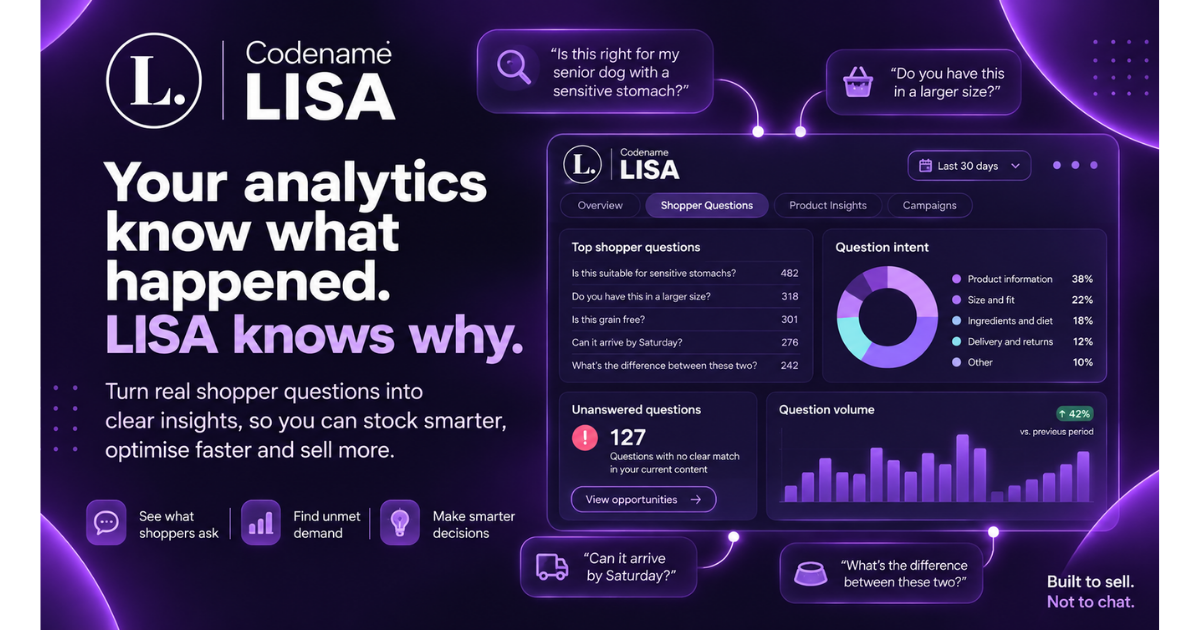
Every single conversation creates a layer of customer intelligence that your standard analytics simply cannot reach. And when you aggregate those conversations across hundreds or thousands of sessions, patterns emerge that are genuinely actionable. Not "bounce rate increased 3% on mobile" - but "fourteen shoppers this week asked whether Product X was suitable for sensitive stomachs, and none of them bought."
That is something you can do something with. That is the difference between data and direction.
The Insight Problem Most Stores Haven't Solved
It's worth being honest about why this gap persists. Standard analytics tools are not broken - they do exactly what they were designed to do. The problem is that ecommerce has evolved and shopper behaviour has become far more complex than a funnel diagram can capture. Shoppers today expect personalized shopping experiences with immediate answers to nuanced questions, and when those answers are not available, they leave without explanation.
Traditional tools were built for a world where the primary job was tracking traffic sources and on-site navigation. They were not built to interpret intent, capture uncertainty or flag the moments where a shopper was close to buying but needed one more piece of information to get there.
That is the world conversational commerce AI was built for.
From Knowing to Acting: The Practical Difference
Understanding why shoppers leave is only useful if it translates into action. And this is where the intelligence gathered through AI-driven conversations starts to compound in value.
Repeated questions about a particular product's compatibility? That tells you the product description needs work. Frequent uncertainty about shipping timelines before checkout? That is a delivery confidence problem you can solve with a single visible change. A pattern of shoppers asking about a product category you do not currently stock? That is a ranging decision hiding in plain sight.
None of that intelligence comes from a bounce rate graph. All of it comes from conversations. And the stores that are capturing it are making smarter decisions - about their product pages, their ranges, their policies and their customer experience - than those still optimizing against what rather than why.
As we have explored before, what your AI assistant should be telling you daily goes well beyond clicks and sessions - it should be surfacing the intent signals your store is already generating but currently discarding.
LISA Insights: Built Around the Question That Matters
This is exactly the problem LISA was designed to address. Every shopper conversation handled by LISA generates structured intelligence - what people searched for, what they were unsure about, what they could not find and what got in the way of the sale.
That intelligence does not just sit in a log file. It surfaces in LISA Insights as patterns you can read, understand and act on - without needing a data analyst or a lengthy audit process. The store owner who checks their LISA dashboard is not looking at session counts. They are reading the actual questions their shoppers asked overnight and seeing which friction points are recurring at scale.
That shift - from recording what happened to understanding why - is not a marginal improvement. It is a fundamentally different relationship between a store and its own customer data. And for stores that are serious about increasing ecommerce conversion rates with AI, it is arguably the most important capability to get right.
Because knowing a shopper left is useful. Knowing why gives you something you can fix.
If you want to see what LISA Insights could surface from your own store's conversations - and what friction points might be hiding in your current data - book a demo and we will show you exactly what LISA sees.