
The Real AI Problem in Retail Isn't the Tools - It's What's Underneath Them
Every week, another retailer announces an AI initiative. A new chatbot. A smarter search bar. A recommendation engine that promises to lift conversions overnight. And yet, for most stores, the results are disappointing. Not because the technology is broken - but because the store beneath it is.
This is the uncomfortable truth that's starting to surface across retail: AI doesn't fix broken infrastructure, it exposes it. And most ecommerce stores, whether they realise it or not, are running on foundations that were never designed to support the kind of intelligence modern shoppers now expect.
What "Infrastructure" Actually Means in Ecommerce
When retailers talk about infrastructure, most people picture servers and databases. But in the context of AI-powered commerce, infrastructure means something far broader. It's the entire system through which a shopper moves - from the moment they land on your store to the moment they buy (or leave).
That includes:
- How your products are described and structured - Are they tagged with enough context for AI to reason about them?
- How shopper intent is captured - Are you learning anything from what people search, click, and ask?
- How decisions get made in real time - Can your store respond to a shopper's specific situation, or does everyone get the same experience?
- How data flows between your tools - Or does it sit in isolated silos that never talk to each other?
Most stores fail on at least three of these four. And when you layer AI on top of a system that can't capture intent, can't personalise in real time, and can't learn from shopper behaviour - you don't get smarter retail. You get expensive noise.
The Gap Between AI Ambition and AI Readiness
There's a widespread assumption that adopting AI is primarily a budget decision. Find the right tool, pay for it, install it, done. But the retailers who are actually seeing meaningful results from AI know it's a readiness decision first.
Readiness means asking harder questions. Not "which AI tool should we buy?" but "what does our store actually know about each shopper right now?" Not "how do we automate customer service?" but "what friction are shoppers experiencing that's causing them to need support in the first place?"
As we explored in our post on why answering customer questions still loses sales, the problem often isn't the answer - it's the fact that the question had to be asked at all. A well-structured store, backed by intelligent AI, removes the question before it forms.
That's the difference between reactive AI and infrastructure-level AI. And right now, most retailers are chasing the former while ignoring the latter.
Why Shoppers Are Forcing This Reckoning
Shopper expectations haven't just risen - they've fundamentally shifted. According to research from Salesforce, 65% of consumers now expect companies to adapt to their changing needs and preferences in real time. Not eventually. Not after they've filled out a preference survey. Right now, in the moment, on the page they're looking at.
That expectation can only be met by a store that has built personalisation into its foundation - not bolted it on as an afterthought. A store where shoppers can express what they actually need rather than being forced to navigate category trees that reflect how the store is organised, not how the shopper thinks.
The stores that are winning right now aren't necessarily the ones with the biggest budgets or the most sophisticated tech stacks. They're the ones that have accepted a simple truth: the shopping experience is the product. Get that wrong, and no amount of ad spend or AI tooling will compensate.
The Hidden Cost of Doing Nothing
Here's what makes this moment particularly sharp for ecommerce store owners: the cost of inaction is no longer theoretical. It's measurable in the conversions you're not getting, the cart abandonment you're not recovering, and the repeat purchases you're not earning.
The average ecommerce conversion rate sits between 2% and 4%. That means for every 100 people who visit your store, up to 98 leave without buying. Some of those exits are inevitable. But a significant portion - research suggests as many as 40% of abandoning shoppers could be converted with the right intervention at the right moment - are recoverable with better infrastructure and smarter AI.
That's not a marginal improvement. That's the difference between a struggling store and a thriving one.
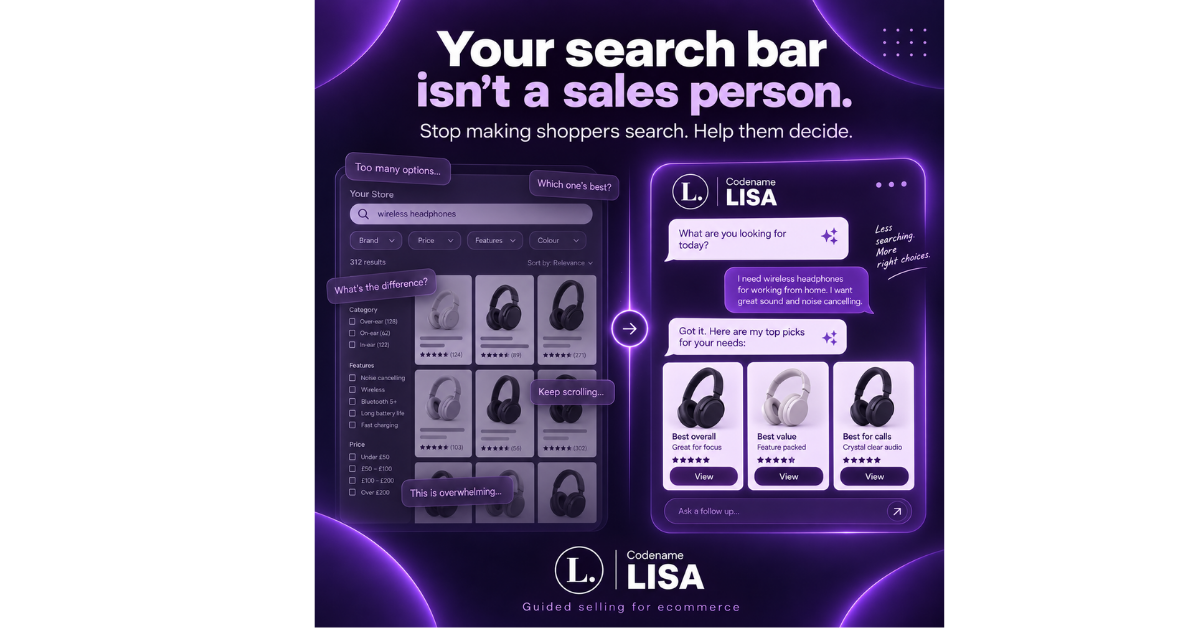
And as we've written about at length in our post on why your ecommerce store is bleeding money, the losses often aren't coming from where store owners expect. They're hiding in product pages, in navigation failures, in the silence between a confused shopper and an unhelpful experience.
What Infrastructure-Level AI Actually Looks Like
So what does it mean to build AI into the foundation rather than the surface? A few things stand out:
It Understands Context, Not Just Queries
A surface-level AI tool responds to what a shopper types. An infrastructure-level AI understands why they're asking - and uses that context to guide them toward the right product. It knows that "something for my dog's joints" is a health concern, not a category search. It responds accordingly.
It Learns From Every Interaction
Infrastructure-level AI doesn't treat each shopper session as an isolated event. It builds a richer understanding of what shoppers want, what confuses them, and where they're falling out of the funnel - and it uses that intelligence to continuously improve the experience. This is the foundation of genuine ecommerce conversion optimization AI rather than one-off tweaks.
It Acts as a Sales Layer, Not a Support Layer
This distinction matters enormously. Most store owners think of AI as a way to deflect customer service queries. But the real opportunity is using AI as an active sales presence - one that guides undecided shoppers, surfaces the right products at the right moment, and delivers the kind of personalized shopping experience AI can provide at scale. As we've explored before, chatbots answer, but AI assistants sell.
It Integrates With What You Already Have
Infrastructure-level AI doesn't require you to tear everything down and start again. It connects to your existing product catalogue, your order data, your customer history - and makes all of it smarter. The goal is augmentation, not replacement.
The Window for Competitive Advantage Is Still Open - But Not for Long
Here's the strategic reality: right now, building genuine AI infrastructure into your ecommerce store is still a differentiator. Most of your competitors are still experimenting with surface-level tools. Most are still treating AI as a feature rather than a foundation.
But that window closes fast. The retailers who move deliberately and thoughtfully now - not just bolting on a chatbot, but genuinely rethinking how their store captures intent, personalises experiences, and converts browsers into buyers - will be the ones who look back on this period as the moment they pulled ahead.
The ones who wait will find themselves playing expensive catch-up in a market where the gap between AI-native stores and traditional ones has become very difficult to close.
LISA is built for exactly this kind of infrastructure-level AI. As an AI shopping assistant for ecommerce, LISA doesn't sit on top of your store like a widget - it operates as an intelligent layer that understands your products, captures shopper intent in real time, delivers AI product recommendations that actually match what shoppers need, and turns conversations into conversions. All without requiring a technical team or a six-figure implementation budget.
This article was inspired by Retail Gazette.
Want to see what infrastructure-level AI actually looks like in practice? Book a demo with the LISA team and we'll show you exactly how it works on your store - and what it could mean for your conversions.