
Fast Follower or Pioneer? Your AI Moment Is Now
There are two types of ecommerce leaders right now. The first is leaning forward, actively experimenting with AI, watching conversion numbers climb, and quietly building a structural advantage over every competitor still sitting on the fence. The second is waiting - watching, deliberating, forming committees, and telling themselves they'll move when the technology "matures a bit more."
Here's the uncomfortable truth: the second group is already behind.
The Boardroom Debate That's Costing You Real Money
Almost every retail leadership team is having the same conversation right now. Some position themselves as "fast followers" - a strategy that sounds prudent but is actually a polished way of saying "we'll let someone else take the risk and copy them later." Others are willing to move early, grab the learning advantage, and build capability while competitors are still in planning mode.
Both positions have genuine strategic logic. But in a market where shopper behaviour is shifting faster than most boardrooms can schedule a follow-up meeting, the cost of waiting is no longer theoretical.
Consider what's happening to search behaviour alone. Large language models now account for roughly 5.6% of all global search volume, and approximately 37% of users are starting their information journeys with AI tools rather than traditional search engines - a figure that was barely a rounding error just two years ago. That's not a gradual transition. That's a structural shift in how people find, evaluate and buy products.
Your shoppers aren't waiting for your board to decide.
What "Waiting" Actually Costs
The fast follower argument assumes the window stays open - that you can observe, learn from early adopters, and then enter cleanly once the path is clearer. In some industries, that's a reasonable bet. In ecommerce, where personalisation, relevance and speed of response are the core battleground, it's increasingly risky.
Here's why. Stores that deploy AI shopping assistants early aren't just adding a feature - they're generating proprietary data about how their specific customers think, what questions they ask before buying, where they hesitate, and what finally tips them toward a purchase. That data compounds. Pioneers build a feedback loop that fast followers can't simply purchase later.
If your store is still relying on static product pages, keyword search bars and reactive customer support emails, you're not just missing a technology upgrade. You're operating a fundamentally different kind of store to your AI-enabled competitors - and your conversion numbers will eventually reflect that gap.
As we explored in "Chatbots Answer. AI Assistants Sell.", there's a meaningful distinction between bolting on a basic FAQ bot and deploying an assistant that actively guides shoppers toward confident purchase decisions. The former is defensive. The latter is a genuine commercial advantage.
Why the Pioneer Advantage Is Real - Not Just Hype
Learning Compounds Faster Than You Think
Stores that adopt conversational commerce tools early don't just benefit from the technology itself. They learn which product questions signal buying intent. They learn where shoppers get confused and abandon. They understand the language their customers actually use - not the language their product descriptions assume. This institutional knowledge becomes a competitive moat that late entrants simply cannot replicate by purchasing the same software six months later.
Shopper Expectations Are Rising, Not Resetting
Once a shopper experiences genuinely helpful AI guidance - an assistant that understands their need, surfaces the right product instantly, and handles follow-up questions without making them dig through FAQs - their tolerance for the alternative drops sharply. The stores that deliver that experience first earn loyalty that's very hard to displace. Research increasingly shows that shoppers actively want AI assistance during the buying process - the demand is already there, waiting to be met.
AI Product Recommendations Drive Measurable Revenue
This isn't theoretical. Stores using AI product recommendations consistently report higher average order values, stronger conversion rates, and reduced cart abandonment - precisely because the assistant is doing what a skilled in-store sales assistant would do: understanding what the shopper actually needs and connecting it to the right product at the right moment. That's not a future promise. It's happening now, in stores that chose to move.
The Real Risk of the Fast Follower Position
There's a version of the fast follower strategy that makes sense: let pioneers absorb the early implementation costs, observe what works, and then move decisively with cleaner information. That's a legitimate playbook in mature, slow-moving markets.
Ecommerce is neither.
The risk isn't that AI technology will be harder to implement later. It's that by the time fast followers act, the personalised shopping experience their AI-enabled competitors are delivering will have already reshaped what shoppers expect as a baseline. Moving then isn't adopting an advantage - it's catching up to a new standard, while the pioneers are already building the next one.
There's also a subtler risk. As we detailed in "Why the Agentic AI Window Is Closing Fast", the window for building genuine AI capability - rather than just plugging in a commodity tool - is narrower than most leaders realise. The stores building structured, intelligent shopper conversations today are laying infrastructure. The stores arriving later will be buying a feature.
How to Move Without Betting Everything
Being a pioneer doesn't mean reckless spending or betting your entire operation on unproven technology. It means moving with intention before the market forces your hand.
A few practical starting points:
- Start with your highest-traffic product categories. Deploy an AI shopping assistant where your conversion gap is most costly, not across your entire catalogue at once.
- Treat early data as the real return. The conversion uplift matters, but the shopper insights you generate - what questions they ask, where they drop off, what language they use - are arguably more valuable long-term.
- Stop optimising around the edges. As we explored in "Checkout Optimisation Won't Save You", most conversion losses happen long before checkout. AI assistance addresses the pre-decision friction that page redesigns and checkout tweaks simply can't reach.
- Measure the right things. Conversion rate is one signal, but watch assisted session value, question-to-purchase rates, and repeat visit behaviour. These tell you whether your AI investment is building lasting advantage or just moving numbers temporarily.
Which Side of This Decision Do You Want to Be On?
In two years, ecommerce leaders will look back at this period and clearly identify the stores that moved and the stores that waited. The technology gap between those two groups will be visible in their conversion data, their customer retention rates, and their ability to compete on something other than price.
The question isn't really "pioneer or fast follower" - it's whether you want to be the store that shaped what your customers expect, or the store that scrambled to meet expectations someone else set.
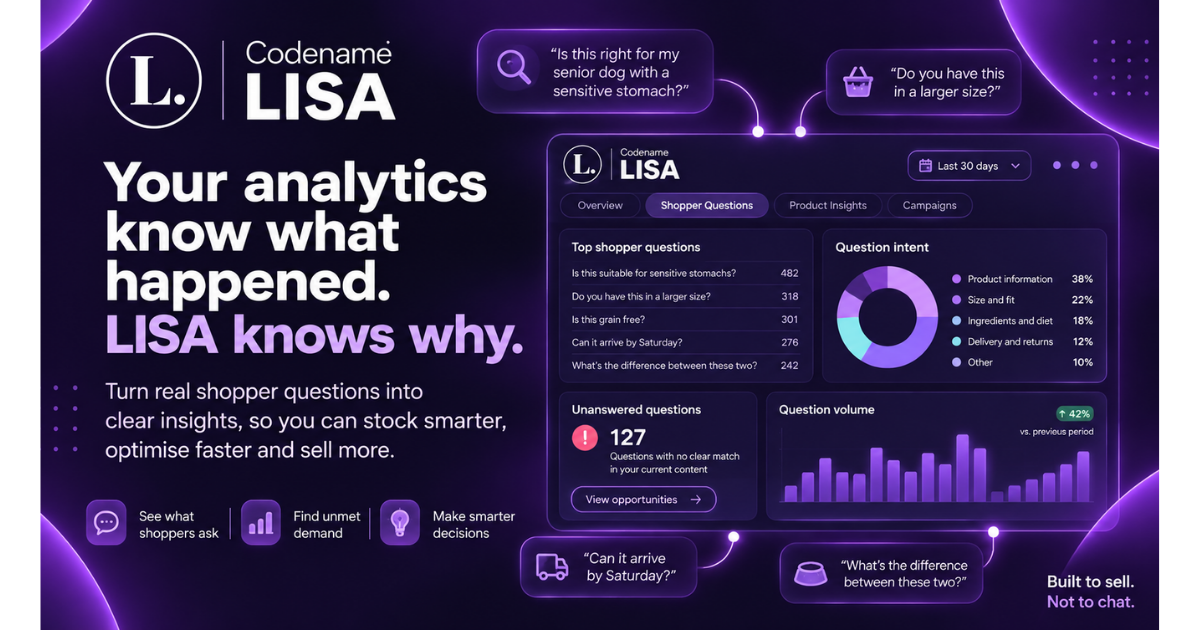
LISA is built for stores that want to move with confidence, not hesitation. As an AI shopping assistant for ecommerce, LISA engages shoppers in real-time, surfaces the right products through intelligent conversation, and turns the shopper data your store generates into genuine commercial intelligence. It's not a chatbot. It's a revenue layer.
This article was inspired by the original article.
If you want to see what LISA can do on your specific store - and understand exactly what shopper insights you're currently missing - book a demo with the LISA team today.
Sources
SEO Sherpa SEO Sherpa AI Search Statistics.