
The Most Valuable Data in Your Store Is Being Ignored
Every ecommerce store owner I speak to has the same obsession: traffic. Where it comes from, how much it costs, whether this week's numbers are up or down on last week. And look, traffic matters. But there is a far richer source of intelligence sitting right under most store owners' noses - and almost nobody is paying attention to it.
The questions your shoppers ask while they are actively trying to buy.
Not survey responses collected weeks after the fact. Not click heatmaps showing you where a cursor hovered. Real, live questions from real people at the exact moment they are deciding whether to hand over their money. That is about as close to pure buyer intent as it gets - and most stores are letting it evaporate into thin air.
One Question Is a Question. Fifty Is a Signal.
Here is how to think about this. If a single shopper asks whether your supplement works for senior dogs, that might just be a curious individual with a specific situation. Fine. You answer it and move on.
But if fifty different shoppers - across different days, different traffic sources, different devices - are all asking versions of the same question? That is not a customer service moment. That is your store sending you a message.
Repeated questions expose gaps. They might point to product descriptions that are not doing their job. They might reveal missing variants that customers are actively searching for. They might uncover compatibility concerns your product page never addresses, or a competing product in your own range that is causing confusion.
Whatever the pattern, it is real. It is current. And it is coming directly from people who want to spend money in your store but are not quite sure they should yet.
Why Traditional Analytics Miss This Entirely
Standard ecommerce analytics are good at telling you what happened. Sessions, bounce rates, funnel drop-offs - all useful in their own way. But they cannot tell you why something happened. They show you the symptom, not the cause.
You can see that 68% of shoppers abandoned a particular product page. What you cannot see - with a dashboard alone - is that most of them left because they were unsure whether the product was compatible with something they already owned, and there was nothing on the page to reassure them.
That gap between what the data shows and what is actually driving behaviour is where stores lose sales every single day. And it is a gap that conversational commerce AI is uniquely placed to fill, because conversation captures intent in a way that clicks simply cannot.
If you want to understand more about where standard analytics fall short, this piece on ecommerce blind spots is worth a read.
The Questions Shoppers Ask (And What They Actually Mean)
Let me give you some examples of the kind of questions that surface repeatedly in stores - and what they are really telling you.
"Do you have this in a larger size?"
On the surface, a simple stock query. But if this comes up repeatedly for the same product, it likely means your sizing options are either limited, unclear, or both. There may be unmet demand for a variant you are not stocking - and that is a ranging decision worth taking seriously.
"Is there one without fragrance?"
A shopper with a sensitivity or preference. One person, sure. But twenty people asking this same question over a month suggests a meaningful segment of your audience has a need your range is not meeting. That is a product development conversation waiting to happen.
"Will this work with the model I already own?"
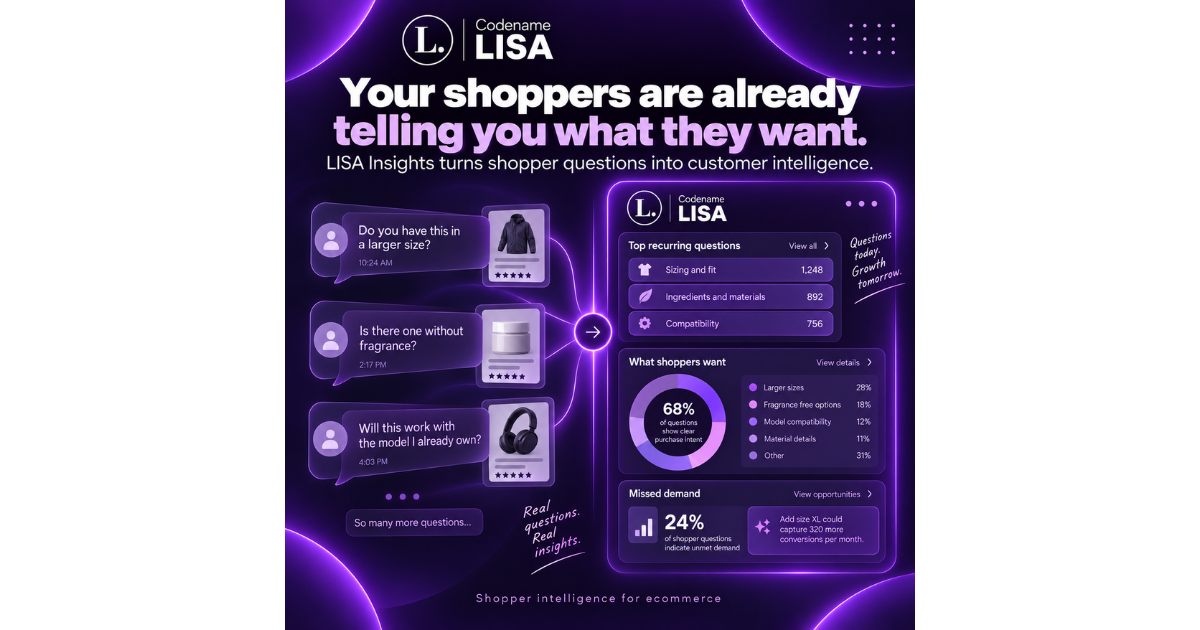
This is a compatibility question - and it is one of the most common reasons shoppers abandon product pages without converting. If your product description does not explicitly address compatibility, or your AI powered product finder is not equipped to answer it, you are losing sales to uncertainty. Uncertainty is one of the quietest conversion killers in ecommerce.
We have written about this pattern before - why answering questions still loses sales is a worthwhile read if this resonates.
Turning Conversations Into Conversion Intelligence
The stores that will win in the next few years are not necessarily the ones with the biggest ad budgets or the most polished product photography. They are the ones that listen better.
Listening at scale - across thousands of shopper interactions - requires the right infrastructure. That means an AI shopping assistant for ecommerce that does more than answer questions in the moment. It means one that captures patterns, surfaces insights, and feeds them back to the people running the store.
This is precisely what LISA Insights does. Every conversation LISA has with a shopper is logged and analysed - not just to deliver a better answer in that session, but to build a picture of what your customers are consistently uncertain about, what variants they keep asking for, and where your product pages are falling short. The result is a living intelligence layer on top of your store that gets more useful over time.
Think about what that means practically. Instead of commissioning a customer survey six months from now and waiting weeks for results, you have a continuously updated view of what your actual buyers are asking - right now, in real time. That is a fundamentally different - and faster - way to make decisions about product listings, stock, content, and ranging.
What to Do With This Information
Once you start surfacing patterns from shopper conversations, the actions become obvious. If the same compatibility question keeps coming up, you update the product description to address it proactively. If a variant keeps being requested and it is feasible to stock, you add it. If a question reveals confusion between two similar products in your range, you improve the way you differentiate them.
These are not complicated changes. But without the signal, most store owners never make them - because they never knew the problem existed.
And the compounding effect matters here. Each fix removes a friction point. Each friction point removed improves conversion. Better ecommerce conversion optimization AI is not always about building something new - sometimes it is about listening well enough to fix what is already broken.
For a deeper look at how shopper listening translates directly into revenue, this piece on listening as a conversion strategy goes into the detail.
The Competitive Advantage Most Stores Are Sleeping On
Your competitors are running the same ad campaigns. They are using the same SEO playbooks. They are probably looking at the same analytics dashboards. What very few of them are doing is systematically mining the conversations their shoppers are having - and turning that into product and content decisions.
That gap will not stay open forever. As more stores adopt AI assistants and start to understand the intelligence layer they create, this kind of personalized shopping experience AI will become table stakes rather than a differentiator. But right now, the window is open.
The stores that move first will accumulate months of shopper intelligence before their competitors even realise it is available. That compounding data advantage is difficult to replicate quickly.
Ready to Hear What Your Shoppers Are Telling You?
If you are curious about what LISA could surface from your store's shopper conversations - and how that intelligence could feed directly into conversion improvements - the best next step is to see it in action on your actual store.
Book a demo with the LISA team and we will show you exactly how it works, what kinds of insights it surfaces, and what that looks like for a store like yours. The questions your shoppers are asking deserve to be heard - and acted on.