
Shopify Just Made AI Agent Visibility a Standard Feature - Here's the Problem
Shopify has been quietly building something significant. Its Storefront MCP - a connection layer that allows AI agents like ChatGPT and Perplexity to read a store's product catalogue and policies - is now something merchants can actively build on. That's a real shift. It means shoppers who use AI agents to research purchases could, in theory, get accurate answers pulled directly from your store.
On the surface, this sounds like a win for every merchant. And to some extent, it is. But if you're a store owner thinking "great, my AI visibility problem is solved," you're reading the situation too optimistically.
Let me explain what Shopify's move actually solves - and what it deliberately leaves on the table.
What the MCP Connection Actually Does
Think of Shopify's Storefront MCP as giving your store a readable front door for AI systems. When a shopper asks ChatGPT "does this store ship to Ireland?" or "what's their return policy on pet food?", the MCP gives those agents somewhere to look for a real answer rather than hallucinating one.
That's genuinely useful. Unanswered questions from external AI agents represent invisible friction - shoppers who never even reach your site because they couldn't get a confident answer at the research stage. Closing that gap matters.
Shopify is also surfacing something called an FAQ query log - a record of what AI agents have been asking about your store from outside your site. Combined with suggestions for FAQ gaps, this gives merchants a clearer picture of the information their store is failing to communicate.
Again, useful. But here's where the nuance matters.
The Difference Between Plumbing and Intelligence
What Shopify has built is infrastructure. It's the connection that lets AI agents access your store data. What it doesn't build is an assistant that actively sells - one that understands what a shopper wanted, how they behaved, what they clicked, and why they left without buying.
This distinction is critical, and it's one that too many store owners underestimate. Answering a question an AI agent asked about your return policy is not the same as guiding a live shopper through a decision in real time. The first is information retrieval. The second is selling.
A shopper who lands on your store already has intent. They're not just researching in the abstract - they're close to a decision. What happens in that moment, on your storefront, is where the real conversion opportunity exists. Shopify's MCP doesn't touch that. It makes your store more readable to external agents. It doesn't make your store better at converting the visitors already inside it.
Why This Raises the Bar - Not Just the Floor
Here's the competitive implication that many store owners will miss. Fashion merchants, in particular, will start seeing FAQ gap suggestions and query logs inside their Shopify admin for free. That means any sales pitch that centres on "we help you find your unanswered questions" becomes much weaker overnight.
The bar for what a meaningful AI shopping assistant for ecommerce should do has just risen. Surface-level FAQ identification is now table stakes. What differentiates a genuinely powerful solution is everything that happens after the question is asked - the live guidance, the product recommendation, the moment a hesitant shopper is nudged toward a decision rather than left to drift toward the back button.
This is exactly the gap that answering questions alone cannot close. Knowing what was asked tells you something. Understanding what the shopper wanted, what they considered, and what made them leave tells you far more.
What Real Shopper Intelligence Looks Like
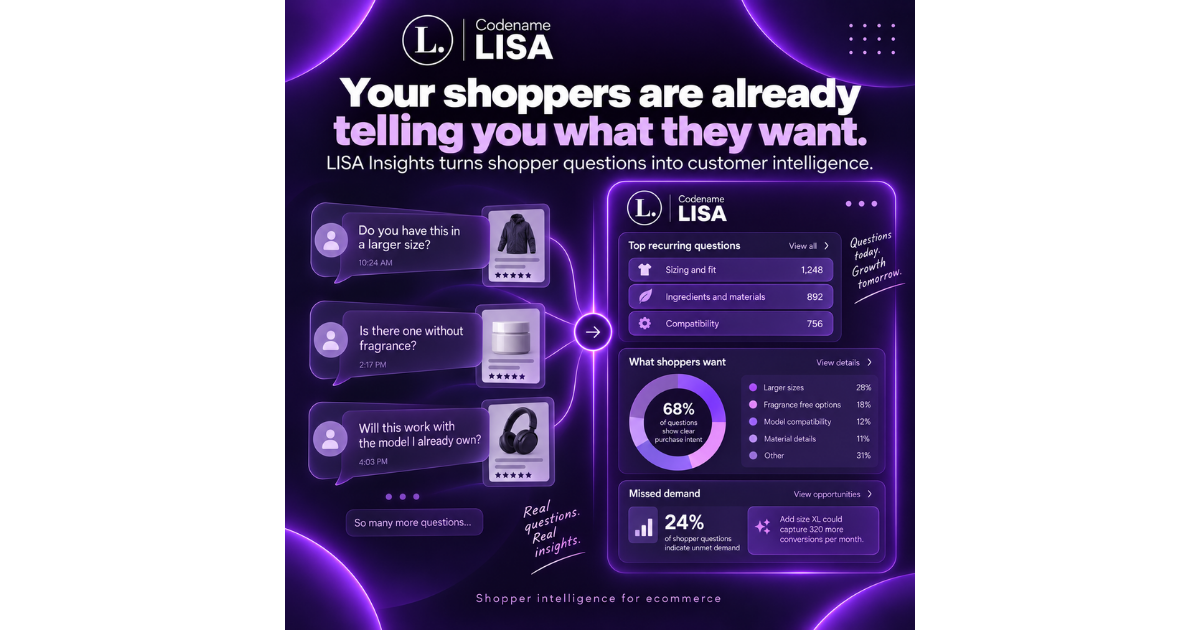
There's a meaningful difference between a query log and shopper intelligence. A query log tells you what questions came in. Shopper intelligence tells you what intent drove those questions, what products were considered, and where the decision broke down.
For ecommerce conversion optimization, the second type of data is infinitely more actionable. It doesn't just highlight gaps in your FAQ - it reveals patterns in your shoppers' decision-making that no static log can capture.
Consider what it would mean to know not just that someone asked about sizing, but that they asked about sizing, browsed three product pages, added one item to their cart, and then left - all without buying. That's a conversion problem, not an information problem. And it requires a different kind of solution.
AI Recommendations That Work in the Moment
The other dimension Shopify's MCP doesn't address is proactive guidance. AI product recommendations that respond to what a shopper is doing right now - not what they asked about in a research session hours earlier - are what actually move conversion rates. Personalisation that adapts in real time, that surfaces the right product at the right moment based on live behaviour, is a fundamentally different capability than catalogue-readability for external agents.
This is where conversational commerce AI earns its value. Not by being a better FAQ, but by replicating the kind of guided experience a skilled in-store salesperson would provide - asking the right questions, narrowing options, building confidence, and closing the sale.
The Opportunity Hidden in Shopify's Move
There is one genuinely exciting possibility buried in this development - and it points in the opposite direction from what most people are discussing.
If an AI assistant on your storefront is learning what shoppers ask, what they need, and what answers actually convert them - that intelligence could feed back into the external knowledge layer. Your store becomes not just readable to AI agents, but better informed by real shopper behaviour. The FAQ that ChatGPT pulls from your store isn't guesswork or static copy - it reflects what your actual customers needed most.
That's a closed loop between live selling intelligence and external AI visibility. It's where personalized shopping experience AI and broader AI agent infrastructure start to work together rather than in parallel.
We're not there yet as an industry standard. But the direction is clear - and stores that build this kind of intelligence layer now will have a compounding advantage over those who treat FAQ optimisation as the finish line.
What Store Owners Should Actually Do Right Now
If you're on Shopify, absolutely take advantage of the MCP connection and review your FAQ query logs when they become available. Close the obvious gaps. Make your store's policies and product information as clear as possible for external AI agents.
But don't mistake that for a conversion strategy. Your store's visibility to AI agents is only valuable if the shoppers those agents send you actually buy something. Traffic without conversion is just noise, whether it comes from a search engine or an AI agent.
The real question is what happens when someone arrives. Are they guided? Are their hesitations addressed? Are they shown the right product at the right moment with the right confidence to buy? That's what a genuine AI shopping assistant solves - and it's what no amount of catalogue-readability infrastructure can replace.
Shopify has built the roads. What drives on them still matters enormously.
LISA is built for exactly that gap - the live selling intelligence that turns store visitors into buyers, while surfacing the shopper behaviour insights that no query log captures. If you want to see what that looks like on your own ecommerce store, book a demo and we'll show you exactly what LISA would do with your traffic.