
The More You Offer, the Less They Buy
There is a counterintuitive truth sitting at the heart of most ecommerce stores right now: the bigger your catalogue, the harder it can be to sell from it. Not because the products are wrong. Not because the prices are off. But because choice, beyond a certain threshold, stops feeling like freedom and starts feeling like a problem the shopper has to solve themselves.
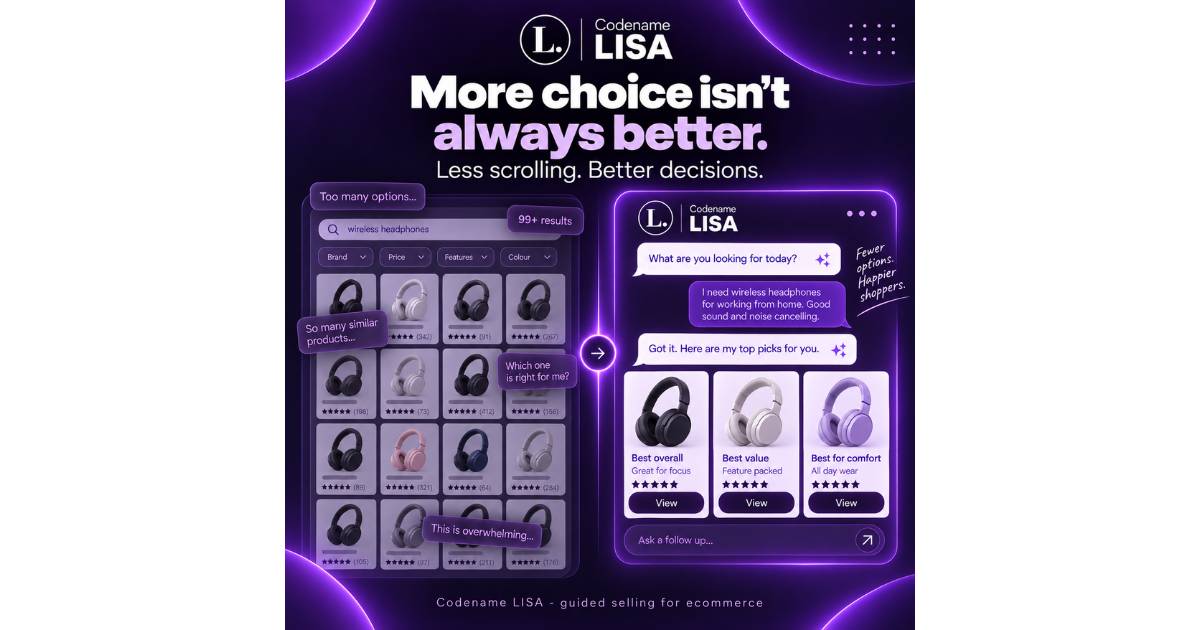
Twelve products feels manageable. Forty-eight starts to feel like a research project. And when a shopper lands on a category page with hundreds of options and no clear direction, the most common response isn't excitement - it's hesitation. And hesitation, in ecommerce, almost always becomes an exit.
This isn't a theory. Psychologists have documented it for decades. The "paradox of choice" - the idea that more options can lead to worse decisions and higher anxiety - is well established in consumer behaviour research. But most ecommerce stores are still built as if more access equals more sales. It doesn't.
Access and Guidance Are Two Very Different Things
Ecommerce platforms have become extraordinarily good at giving shoppers access to enormous product catalogues. Filtering tools, sorting options, category trees - they're all designed to let people find things. But finding and deciding are not the same cognitive task.
Finding requires navigation. Deciding requires confidence. And confidence comes from feeling like the right answer has been identified - not just that the options have been displayed.
Think about the difference between walking into a store with a knowledgeable assistant versus walking into a warehouse with a search engine. One narrows the world down for you based on what you actually need. The other hands you a map and wishes you luck.
Most online stores are still the warehouse. They surface everything and let the shopper figure out the rest. The stores that are starting to win are the ones treating the shopping experience more like the assistant - asking the right questions, filtering out the noise, and pointing people toward the option that genuinely fits.
Why Guided Selling Changes the Conversion Equation
Guided selling isn't a new idea, but AI has made it practically achievable for stores of every size. Instead of relying on a shopper to know exactly what they're looking for before they arrive, a well-designed AI shopping assistant meets them where they are - uncertain, browsing, or overwhelmed - and helps them move forward.
That might mean asking a few questions to understand their specific situation. It might mean surfacing three relevant options instead of thirty. It might mean explaining why one product fits better than another, based on what the shopper has already indicated they care about.
The result is less scrolling, fewer dead ends, and a faster path to a decision the shopper actually feels good about. And when shoppers feel confident in their choice, they're not just more likely to buy - they're less likely to return the product, less likely to contact support afterwards, and more likely to come back.
For stores investing in ecommerce conversion optimization AI, guided selling represents one of the highest-leverage opportunities available. It doesn't require a catalogue overhaul. It doesn't mean removing products. It just means adding intelligence to the discovery process that was previously missing.
The Real Cost of Doing Nothing
It's tempting to assume that a large catalogue is a strength - and in some ways, it is. Range is a competitive advantage when it's navigable. But when shoppers can't efficiently find what they need, range becomes a liability.
High bounce rates on category pages, low add-to-cart rates, and abandoned sessions after long browsing periods are all symptoms of the same underlying problem: shoppers are working too hard and getting too little help. As we've explored before, 97 out of every 100 shoppers leave most stores without buying - and choice overwhelm is one of the most underappreciated reasons why.
The cost isn't just the lost sale in the moment. It's the ad spend that brought that shopper to the store, now generating no return. It's the remarketing budget required to try and win them back. It's the compounding effect of a conversion rate that never improves because the core experience hasn't changed.
As we've written about previously, traffic is rarely the problem for struggling stores - it's what happens after the click that determines whether that investment pays off.
What AI Product Recommendations Actually Do
When people hear "AI product recommendations," they often picture the "customers also bought" carousel at the bottom of a product page. That's one version of it - and it's useful. But it's a passive form of guidance. It waits for the shopper to already be on a page before offering any direction.
A genuinely intelligent shopping assistant takes a more proactive approach. It engages with shoppers earlier in the journey, before they've committed to a product or even a category. It helps them articulate what they need, even when they arrive without a clear brief. And it uses that understanding to surface fewer options, not more - specifically the ones most likely to result in a confident purchase.
This is where conversational commerce AI earns its value. Not by replacing the catalogue, but by acting as the layer between a shopper's uncertain intent and the right product. The AI powered product finder approach treats every shopper as an individual with a specific context, not just a session to be monetised.
What That Looks Like in Practice
A shopper arrives looking for a gift but isn't sure what the recipient would prefer. Instead of being dropped into a 200-item "gifts" category, a conversational assistant asks a few simple questions - budget, the recipient's interests, whether they've bought from the store before - and returns a curated shortlist with clear reasoning for each suggestion.
Another shopper knows they want a specific type of product but is confused by the technical variations. Rather than reading through seven product descriptions hoping the difference becomes clear, the assistant explains it plainly and recommends the right fit based on how they'll actually use it.
In both cases, the shopper does less work. The store does more. And the outcome - a confident purchase decision - becomes significantly more likely.
Guidance Is the New Competitive Edge
The stores that will win in the next phase of ecommerce aren't necessarily the ones with the widest range or the lowest prices. They're the ones that make buying easy in a way that feels personal rather than transactional.
Expanding a catalogue is straightforward. Adding personalized shopping experience AI that helps shoppers navigate it intelligently is where the real differentiation lives - and where the conversion gains are most significant. As the broader landscape of AI redefines ecommerce expectations, guidance is becoming a baseline requirement, not a premium feature.
LISA is built specifically to solve this problem. As an AI shopping assistant for ecommerce, LISA engages shoppers in natural conversation, asks the right questions, and delivers product recommendations that feel considered rather than algorithmic. The result is a shorter path from browsing to buying - without reducing catalogue size or overhauling the store.
If your store is carrying the weight of a large catalogue but not seeing the conversion rates to match, book a demo with the LISA team and see exactly how guided selling could work on your store. The products are already there. The guidance is what's missing.