
Your Campaign Reports Are Lying to You (Not Intentionally)
Every week, store owners check the same numbers. Clicks. Impressions. Cost per acquisition. Return on ad spend. And on the surface, these metrics feel like the full story. They're not.
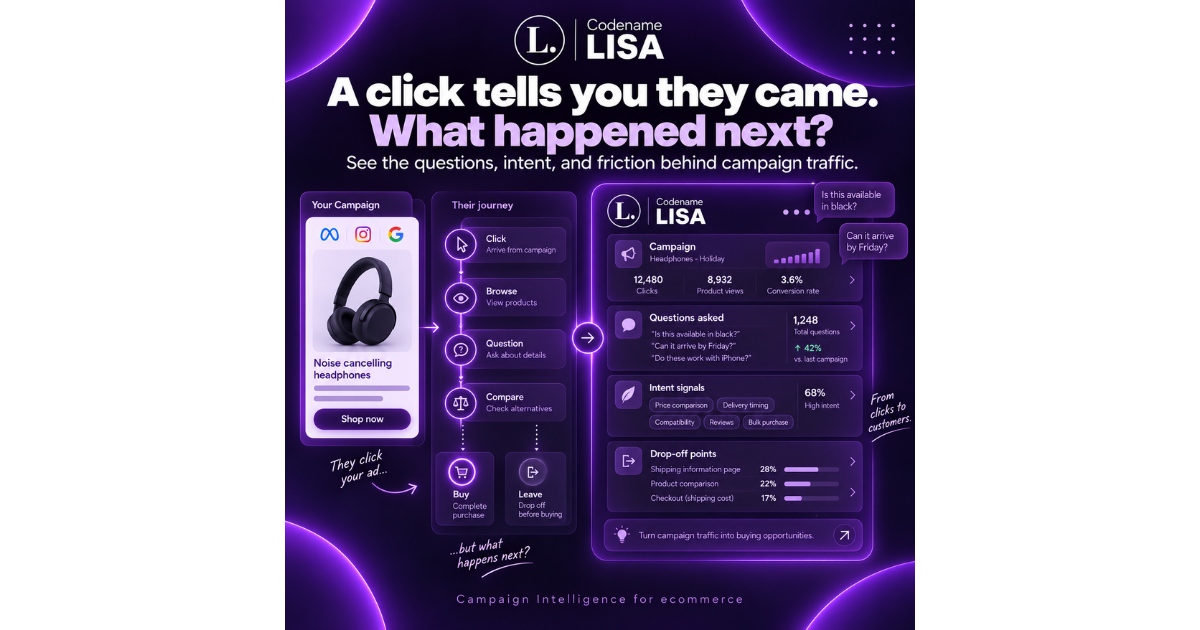
A click tells you that your creative was compelling enough to earn attention for a fraction of a second. That's it. What happens next - the browsing, the hesitation, the questions, the comparison-shopping, the quiet exit - that entire chapter of the customer journey is completely invisible inside most campaign dashboards.
And here's the uncomfortable truth: the most important commercial signals your shoppers send happen between the click and the conversion. Traditional reporting skips right over them.
The Gap Nobody Talks About
Think about what a shopper actually does after clicking an ad. They land on a product page. They scroll. Maybe they check sizing information, or want to know if an item ships fast enough. They might search for a specific variant. They compare two products. They wonder about your returns policy. And then - in the majority of cases - they leave.
According to data from the Baymard Institute, the average documented online cart abandonment rate sits at nearly 70%. But product page abandonment happens even before shoppers get that far. Visitors are making decisions - and walking away - at every single stage of the journey, and most attribution tools only capture the endpoints.
The result? You optimise for clicks because that's what you can measure. You A/B test headlines and images. You adjust bids. You tweak audience targeting. But the actual questions that determined whether someone bought or bounced? Completely invisible.
What Shoppers Are Actually Doing Between Click and Checkout
They're asking questions your page doesn't answer
A visitor arrives from your paid ad and immediately wants to know whether a product comes in a specific colour, or whether it's compatible with something they already own. If that answer isn't immediately obvious, they don't email you. They don't wait. They leave and find a competitor who makes it easier.
They're searching for reassurance
Trust is earned in micro-moments. Shoppers check delivery timelines, look for reviews, hunt for guarantee information. Every unanswered question is a potential exit point - and without visibility into those questions, you have no way of knowing which objections are actually costing you revenue.
They're comparing and reconsidering
Someone who clicked your ad might genuinely love your product but still hesitate. They browse alternatives within your store, look at different variants, and weigh options. The silent customer doesn't tell you any of this - they just vanish from your analytics as another bounce.
Why "Did This Campaign Convert?" Is the Wrong Question
Most store owners evaluate campaigns with a binary lens: did the click turn into a sale, or didn't it? But that question only captures one dimension of what a campaign actually does.
A better set of questions looks more like this:
- What did shoppers from this campaign ask about most?
- Where in the journey did they disengage?
- Which product objections came up repeatedly?
- What buying signals did they show before leaving?
These questions reveal intent - and intent is far more actionable than a click count. If shoppers from your Facebook campaign consistently ask about delivery times before dropping off, that's not a media buying problem. That's a product page problem. And no amount of bid adjustment will fix it.
This is the kind of insight that separates stores that scale efficiently from those that perpetually pour budget into campaigns without understanding why conversion rates plateau. If your traffic isn't converting, the problem is rarely the traffic itself.
How AI Changes What's Measurable
This is where AI shopping assistant for ecommerce technology starts to show its real value - not just as a customer-facing tool, but as a source of commercial intelligence.
When an AI assistant is embedded in your store, every shopper interaction generates a signal. What they searched for. What questions they asked. Which products they compared. Where the conversation stalled. This turns the previously invisible middle of the customer journey into structured, queryable data.
Suddenly, instead of guessing why a campaign underperformed, you can see exactly what the shoppers it attracted were trying to understand - and where your store failed to give them confidence.
This shifts ecommerce conversion optimization from a reactive exercise (fixing problems you've already lost revenue to) into something proactive. You identify friction before it becomes a pattern. You address objections before they become abandoned sessions.
Connecting Campaigns to Intent - Not Just Clicks
LISA's Campaign Intelligence layer is built on this principle. Rather than treating a campaign as a traffic source with a conversion attached, it connects each traffic channel to the actual shopping behaviour that followed - the questions asked, the products explored, the moments of hesitation.
The result is a fundamentally different kind of reporting. Instead of knowing that 3,000 people clicked your ad and 87 bought something, you also know that 600 of those visitors asked about gift packaging, that 400 searched for a variant you don't stock, and that your returns policy was the single most frequently raised concern across that audience segment.
That's not just reporting. That's a roadmap. What your AI assistant surfaces in its analytics dashboard should be actively shaping your product decisions, your content strategy, and your campaign targeting - not just sitting in a report that nobody acts on.
The Cost of Running Blind
For context on what's at stake: global cart abandonment represents trillions in lost ecommerce revenue annually. But the real number is even larger when you account for shoppers who never made it to the cart - who saw your ad, visited your store, had a genuine intent to buy, and left because something small and fixable got in the way.
Without intelligence on what that "something" was, every campaign you run faces the same invisible ceiling. You bring people in. You lose them in the middle. You optimise the front end and wonder why the overall numbers don't move.
Conversational commerce AI doesn't just improve the shopper experience in the moment - it makes the invisible visible. And when you can see where shoppers lose confidence, you can actually do something about it.
Start Asking Better Questions
The click is not the insight. It's the beginning of a story that most stores never get to read. If your current reporting stops at the click and jumps to the conversion, you're making campaign decisions with half the data you need.
Connecting campaign traffic to shopper intent - in real time, at scale - is what separates stores that grow intelligently from those that grow expensively.
If you want to see how LISA surfaces campaign-level buying intelligence across your store, book a demo and we'll show you exactly what your campaigns are actually making shoppers want.